Nature
 PUBLISHED
 2
2


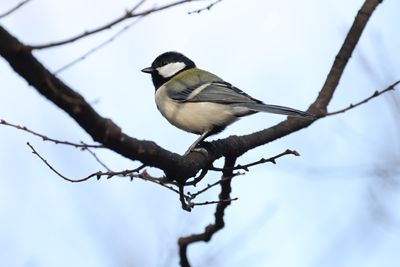


What is your favorite gesture? A little thumbs up? The funny squiggle in the air when you want the check in a restaurant or even something ruder? Well, scientists have discovered that apes and humans aren’t the only ones making gestures. The Japanese tits (Parus minor) are getting in on the act and being downright polite about it to boot.
Japanese tits form mating pairs in the spring and build a nest with a small entrance hole. The hole does not allow both birds to enter at the same time so they must go into the nest one after the other. Researchers from the University of Tokyo found that the birds have a wing-fluttering gesture that they use to communicate with their mates that simply indicates “After you”.
“In our latest discovery, we revealed that the Japanese tit uses gestures to communicate with their mate,” said Associate Professor Toshitaka Suzuki in a statement.
Suzuki and co-author Norimasa Sugita observed eight pairs of parent birds breeding in nest boxes. Before entering the nest with food, the two birds would often sit on a perch outside the nest first, until one of the pair fluttered their wings at the other bird. The bird not fluttering then entered the nest first. They found that more often than not it was the female that fluttered her wings at the male and if she did not, she entered the nest first. Only one of the eight males was seen to use the wing-fluttering gesture. They also found that the order in which the male and female birds arrived at the perches above the nest entrance did not determine who entered the nest first.
“We were surprised to find that the results were much clearer than we had expected. We observed that Japanese tits flutter their wings exclusively in the presence of their mate, and upon witnessing this behavior, the mate almost always entered the nest box first,” explained Suzuki.
Overall, the team looked at 321 nest visits in detail. Gestures can be classified into deictic gestures such as pointing out an object or symbolic gestures that convey messages. These symbolic gestures require more complex cognitive skills.
The wing fluttering gesture only appeared in the presence of a mate and stopped when the mate entered the nest box without physical contact between the pair, leading the researchers to believe it was a true symbolic gesture.
“There is a hypothesis that walking on two legs allowed humans to maintain an upright posture, freeing up their hands for greater mobility, which in turn contributed to the evolution of gestures. Similarly, when birds perch on branches, their wings become free, which we think may facilitate the development of gestural communication,” explained Suzuki.
Previously these birds have been found to combine calls and sing with syntax. Now, they have been found to use gestures, opening up more avenues for research into what these birds are capable of when it comes to communication.
“We will continue to decipher what birds are talking about through gestures, vocalizations, and their combinations. This endeavor not only enables us to uncover the rich world of animal languages, but also serves as a crucial key to unravelling the origins and evolution of our own language,” finished Suzuki.
The paper is published in Cell Biology.