Nature
 PUBLISHED


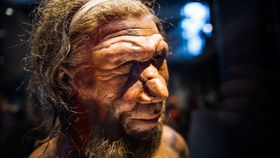


What killed off the Neanderthals? It’s often posed that the Neanderthals, our heavy-browed cousins that stomped around Europe and western Asia until 40,000 years ago, were pushed into extinction by humans. However, new research has perhaps let us off the hook.
Instead of being outcompeted by humans, the new study argues that small populations and inbreeding, together with “a stroke of bad luck,” were responsible for the demise of the Neanderthals.
Reporting in the journal PLOS ONE, a team from the Eindhoven University of Technology in the Netherlands used data from present-day hunter-gatherer populations to develop models of Neanderthal populations.
The team modeled populations of various sizes (50, 100, 500, 1,000, or 5,000 individuals) and assessed how they fared in different circumstances. The scenarios largely centered around three different factors: levels of inbreeding, natural fluctuations in births, deaths, and sex ratios, and the Allee effect (where reduced population size negatively impacts individuals' fitness).
According to the models, inbreeding alone was unlikely to have led to extinction. However, inbreeding combined with Allee effects and demographic shifts in the population would be enough to spark the demise.
Still, the question remains, what happened about 40,000 years ago to put the final nail in the coffin? Is it mere coincidence that anatomically modern humans reached Europe around 40,000 years ago?
The introduction of humans to the neighborhood undoubtedly made life harder for the native Neanderthal population in terms of competition, however, it looks like the decisive blow might have just been bad luck.
"Did Neanderthals disappear because of us? No, this study suggests. The species' demise might have been due merely to a stroke of bad, demographic luck," the researchers explain.
“Our results are consistent with a scenario in which a small population of Neanderthals persists for several thousands of years, and then, due to a stroke of bad luck, disappears,” the researchers write in the study.
It's worth remembering that this is just one of many theories out there. The question of why the Neandthernals' extinction remains a hotly debated topic, with researchers offering a range of explanations, including competition by immigrating humans, inbreeding, climate change, disease, and – the most likely scenario – a combination of these factors.
Neanderthals are often branded as slow-witted lumbering early humans. However, an increasing amount of evidence is suggesting that they were surprisingly intelligent and deeply creative, just like us. Researchers now believe that much of Europe’s cave art was, in fact, painted by Neandethernals. We also know that Neanderthals crafted jewelry and ornaments out of eagle talons.
Humans and Neanderthals also interbred with each other, leaving behind a genetic legacy than can still be seen today in the DNA of all non-African populations. In fact, there's strong evidence to suggest that these "Neanderthal genes" may even influence risk of depression, heart attack, and a range of other health problems.