Space and Physics
 PUBLISHED
 2
2





We often hear the term "stamp collecting" referring to something considered by many to be fairly dull. Well, the people who use it that way have certainly never heard about the Apollo 15 postal covers incident, a scandal involving postal covers being flown to the surface of the Moon and ending with the three astronauts never returning to space.
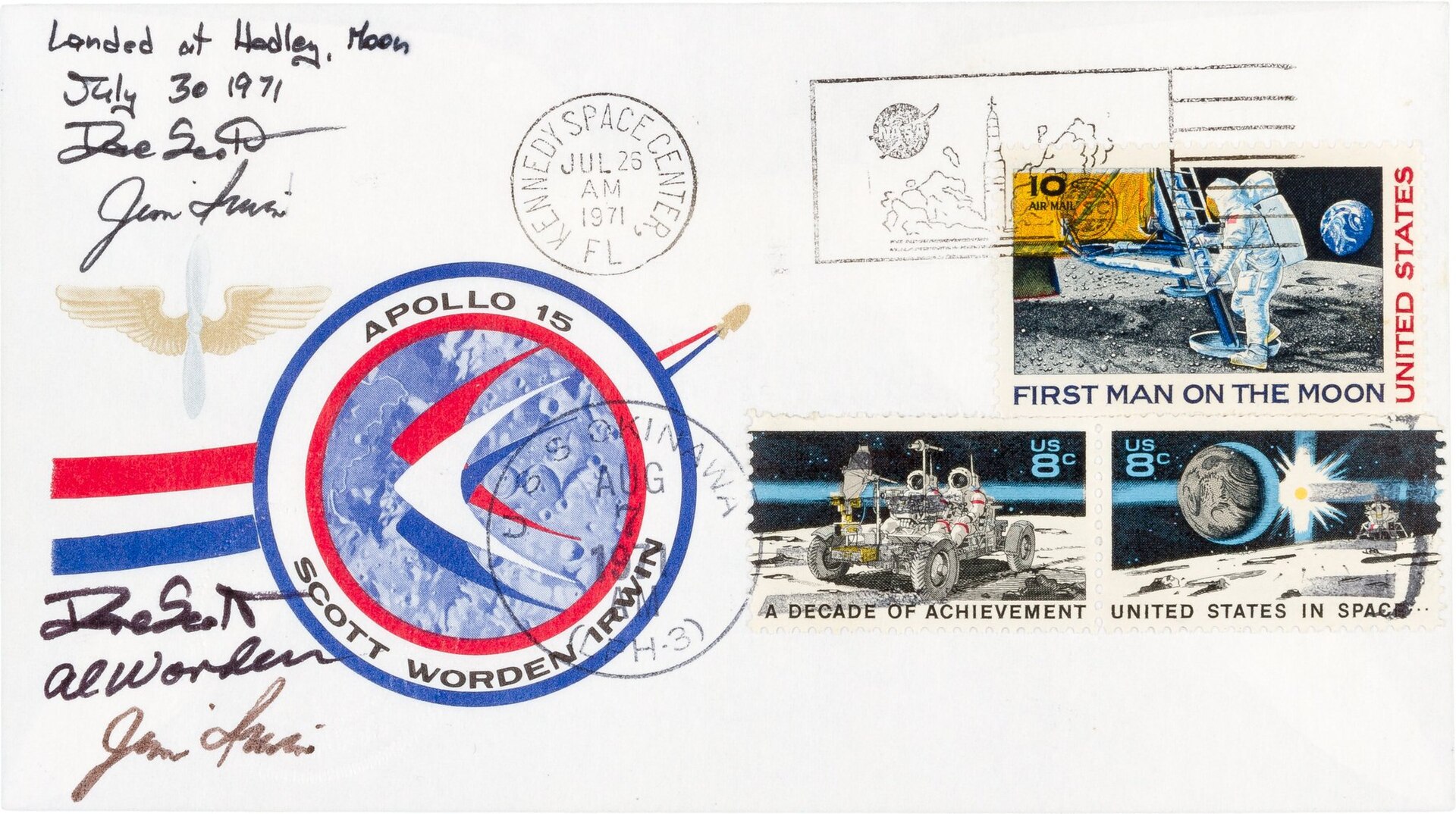
First of all, what is a postal cover? They are stamped and postmarked envelopes that are bought and sold at auction by stamp enthusiasts, known as philatelists. In some cases, postmarks devalue rare stamps, but in other cases, if they mark a special date or dates – like in this case – the value is much increased.
Postal covers were a common object for astronauts to prepare for themselves and bring into space. They flew on Apollo 11, Apollo 13, and Apollo 14. Ed Mitchell, who landed on the Moon with Apollo 14, brought his to the lunar surface. Neil Armstrong, the first man on the Moon, held onto his until he died. It was sold only in 2018, several years after his death, for $156,250.
The Apollo 15 crew was approved to carry 241 covers, including one for Barbara Gordon, the wife of Apollo 12 astronaut Dick Gordon. She was an avid stamp collector, but her husband had not carried any to the moon. Bringing postal covers in the astronauts' Personal Preference Kits was, therefore, quite alright… but they decided to smuggle 400 more without telling anyone.
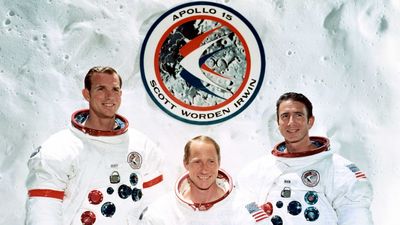
Apollo 15 was the fourth Moon landing of the Apollo Program, and the ninth crewed mission. Aboard were Commander David Scott and Lunar Module Pilot James Irwin, and Command Module Pilot Alfred Worden, who orbited the Moon while the other two landed on its surface.
Al Worden holds the record for the farthest spacewalk from Earth, when the mission was 321,869 kilometers (200,000 miles) from home. They also performed the famous Galileo “Hammer & Feather” experiment, proving that objects of different masses fall with the same acceleration.
But back to the smuggling. On the approved list of items that could be taken, there were 144 covers for an acquaintance of Worden's by the name of F. Herrick Herrick, a retired movie director and stamp collector. Those covers were designed to show the phases of the Moon. The plan, as it was pitched to Worden, was to wait for the Apollo program to end, for the astronauts to retire, and only then would the covers be sold.
The almost 400 smuggled covers, on the other hand, were for West German stamp dealer Hermann Sieger. The covers were also designed, this time by Scott, showing the mission patch, stamps marking the astronauts on the Moon, postmarked with the launch date from the Kennedy Space Center and the splashdown on the USS Okinawa. The cover was signed by the astronauts. These became known as the Sieger covers.
The motivation for this smuggling operation was obviously monetary, but Worden provides some nuance to that. They were not just trying to make a quick buck. Earlier astronauts had been given free life insurance (by none other than Life magazine). This was not available for the Apollo 15 crew, and Worden has argued that the postal covers could be used to make sure that their families were provided for.
The downfall was not the Sieger covers, but the Herrick ones. The retired director did not wait to start selling the covers, and just a few months after their return to Earth, the astronauts' supervisor, Deke Slayton, heard about the sales and warned Worden to stop them. And then he learned about the Sieger deal. In his autobiography, Slayton described it as a "regular goddamn scandal" and added, "they told me what the deal was, and I got pretty goddamn angry. So I was through with Scott, Worden, and Irwin. After 16 splashed down, I kicked them off the backup crew for 17."
The public discussion was in full swing about space and making money from it – as internal investigations were taking place, the story broke in The Washington Sunday Star on June 18, 1972. Due to the increased publicity about the incident, the Senate Committee on Aeronautical and Space Sciences called a closed-door hearing to ascertain the facts about these events.
The three astronauts were reprimanded and never flew to space again, but Scott and Worden remained involved with NASA and the space sector. Irwin went on to found an evangelical religious group. The astronauts gave back the money they got from Sieger. While they broke the NASA code of conduct, they did not commit a crime.
Sometimes, in space scandals, accusations of crimes develop with a lot less evidence. In 2023, NASA astronaut Frank Rubio was accused of having stolen and eaten a tomato from a science experiment. The tomato, sealed in a Ziplock bag, was found again eight months later.