Nature
 PUBLISHED


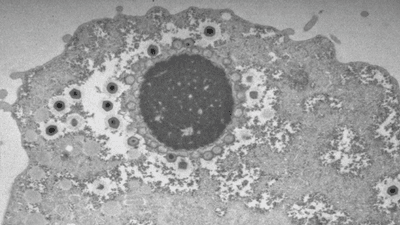


A newly discovered giant virus is helping researchers understand how one of biology's most unusual groups diversified – and how even closely related viruses can diverge in their strategies for exploiting host cells.
The virus, named furtivovirus, was isolated from river samples in Kamakura, Japan, and cultured in the lab using a common soil amoeba. At around 200 nanometers across, it is among the smaller of the “giant viruses” – a group that can reach 10 times that size and whose first known member, Mimivirus, spent 11 years mistakenly categorized as a bacterium before it was recognized as a virus in 2003.
Giant viruses are defined partly by how much they can do for themselves, carrying genes for processes most smaller viruses leave to their hosts. Beyond that, some also carry genes more commonly associated with complex cellular life than with viruses, including genes for sugar fermentation, histones, and the cytoskeleton.
How giant viruses got so large, and how they ended up with such an odd complement of genes, is debated: one hypothesis holds that they accumulated genetic material by picking it up from host organisms over time; another that they evolved from more complex ancestors whose genomes have actually reduced in size.
The team’s analysis revealed that furtivovirus has a genome of about 560,000 base pairs and replicates in a unique way. It depends on the host cell nucleus (the membrane-bound compartment found in all complex life, from yeast to humans), but instead of keeping it intact, it disrupts the nuclear membrane and produces new virus particles in the interior where DNA is normally stored and processed.
This behavior differs from that of two other kinds of giant virus: medusaviruses, which replicate inside an intact nucleus, and ushikuvirus, which forms replication sites in the cytoplasm after breaking down the nucleus.
"Although these viruses belong to the same group, they use the cell nucleus in different ways," said Masaharu Takemura at Tokyo University of Science, in a statement. "If we can understand how giant viruses and host cells interact and evolve together, we may gain new insights into the significance of viruses as living organisms."
Based on comparison with the genomes of other giant viruses, the paper proposes placing furtivovirus and several close relatives, including ushikuvirus, within a new viral family, Manesviridae, and challenges a previous hypothesis that placed this lineage within an order called Pandoravirales, finding insufficient shared genetic material to support that grouping.
The shared nuclear dependence across all three viruses is relevant to a broader question in evolutionary biology. A hypothesis proposed by Takemura in 2001 – and developed independently by Australian microbiologist Philip Bell shortly after – holds that the nucleus of eukaryotic cells may have originated from ancient viruses.
The idea is highly contested; most researchers favor models in which the nucleus emerged from an ancient merger between simpler cellular organisms, namely bacteria and archaea, without involving viruses at all.
The paper is published in the Journal of Virology.



 1
1