Nature
 PUBLISHED


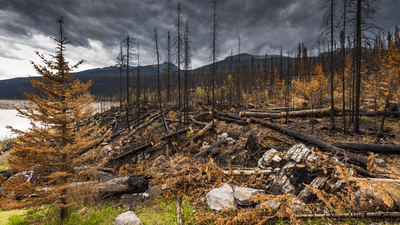


Earlier this year, a devastating wildfire ripped through 33,048 hectares (81,663 acres) of land in Jasper National Park in Canada. According to the BBC, it was the park's worst wildfire of the last century, and yet already a new forest is emerging from the ash.
"This fire has even surprised me as a fire ecologist, with how quickly a lot of the ground cover has already started to come back," said Landon Shepherd of Parks Canada to CTV News. "Even in the very severely impacted sites, both the rhizomes and the more extensive root systems of some of the trees and shrubs that were removed have already started to sprout pretty vigorously."
The fire that ripped through the Alberta landscape grew to such an extent because it was the culmination of several wildfires joining together. When fires get this big, they can create their own weather systems, which is precisely what happened in Jasper National Park.
When the ground burns it creates hot air that rises, making space for cool air to come rushing in. As atmospheric scientist Kyle Hilburn told Live Science, this can lead to a particular kind of cloud formation.
“If the temperature cools rapidly with elevation above the ground, then the rising air will always be warmer than its surroundings and it will keep rising. If it rises high enough, the moisture will condense, forming a cloud known as a pyrocumulus or flammagenitus.”
The wildfire in Jasper saw the creation of a fire-generated thunderstorm known as a pyrocumulonimbus storm, and it was powerful enough to create winds that could topple a shipping container. The unique conditions generated by these storms make wildfires even harder to put out for firefighters, and the fire in Alberta is still burning albeit it now under control. Concerningly, it’s a situation that may be on the rise.
“There’s been an increasing number of large and intense wildfires in North America in recent years that likely would suggest there would be more [pyrocumulonimbus storms],” David Peterson, a meteorologist at the US Naval Research Laboratory in Monterey, California, told The New York Times, “But we still don’t know enough.”
In spite of the devastation, Jasper National Park endures, and the consequences of the blaze aren’t all bad.
“This area needed to have fire," added Shepherd. "[It] is going to become beautiful in its own way, and very important to a lot of species that haven't had that sort of younger forest as habitat for a while.”
"We're actually in very good shape for the next 25 to 30 years. You're tending to have less intense fire behaviour in mixed fuels, fuels that include a high component of leafy vegetation, which is often what comes back following a wildfire."
Wildfire of the century? Make that the comeback of the century.