Nature
 PUBLISHED
 1
1


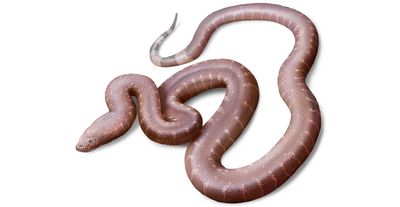


An ancient species of snake has been found in England, and it is – and this is a scientific term – “bizarre”. We’re not kidding: that’s literally the word used in the peer-reviewed paper detailing its discovery. And the cherry on top? It was, like a surprisingly large number of such discoveries, found in a drawer in a museum.
“It was my childhood dream to be able to visit the Natural History Museum, let alone do research there,” Dr Georgios Georgalis, a researcher at the Institute of Systematics and Evolution of Animals of the Polish Academy of Sciences in Krakow and lead author of the new paper, told the Natural History Museum, London. “So, when I saw these very weird vertebrae in the collection and knew that they were something new, it was a fantastic feeling.”
Originally found in 1981, in Hordle Cliff on England’s south coast, the snake has been identified from just 31 tiny vertebrae – some species have more than 500 of these bones, and few have less than 175. There’s no skull, so working out what it ate is a non-starter; the vertebrae are complete enough to conclude that they come from one species, but show no signs of a particularly specialized lifestyle or habitat.
It is, in total, rather a mystery – which is one reason for its newly-coined scientific name: Paradoxophidion richardoweni, the paradoxical snake.
That’s not the only confusing thing about it. P. richardoweni is evidently something of an ur-snake: dating from around 37 million years ago, it’s so old that it seems to combine a mix of features that, today, are associated with very different groups of snakes. It has short spinal vertebrae like one genus, but not its keeled underside; it’s pretty similar to Acrochordus, a group of entirely aquatic snakes sometimes called the “elephant trunk snakes”, except that it’s nowhere near the right place or time for that to make sense.
“It’s possible that this snake could be the oldest known member of this family,” Georgalis suggested. “If it was, then it could mean that it was an aquatic species.”
“On the other hand, it might belong to a completely different group of caenophidians,” he said. It’s too weird a shape to be any other known species, leaving the only conclusion – for now – being that it’s simply something new. “There’s just not enough evidence at the moment to prove how this snake might have lived, or which family it belongs to."
Still, however the snake may have looked or behaved, it’s certainly in good company. Hordle Cliff has long been known for its Eocene-era fossils: the first ones in the area were found by Barbara Rawdon-Hastings in the early 1800s, and they were from crocodilians; since then, fossil-hunters have found ancient turtles, lizards, tapir-like mammals, and, of course, snakes.
“The fossil snakes found at Hordle Cliff were some of the first to be recognised when Richard Owen studied them in the mid-19th century,” Georgalis pointed out. “They include Paleryx, the first named constrictor snake in the fossil record.” Owen, who coined the term "Dinosauria" in 1842, is the founder of the Natural History Museum, London.
If all those species sound a little too tropical for England, there’s a good reason for that. “Around 37 million years ago, England was much warmer than it is now,” explained Marc Jones, curator of fossil reptiles and amphibians at the Natural History Museum, and coauthor of the research. “Though the Sun was very slightly dimmer, levels of atmospheric carbon dioxide were much higher.”
“England was also slightly closer to the equator, meaning that it received more heat from the Sun year round,” he added.
With such a lot of questions still unanswered around the little snake – and with so many of its brethren serpentine fossils equally ignored in the collections of the Natural History Museum – Georgalis’s future path is clear.
“I’m planning to study a variety of snake fossils in the collection, including those originally studied by Richard Owen,” he confirmed. “These include the remains of the giant aquatic snake Palaeophis, which were first found in England in the 19th century.”
“There are also several bones with differing morphology that haven’t been investigated before that I’m interested in looking at. These might represent new taxa and offer additional clues about snake evolution.”
The study is published in the journal Comptes Rendus Palevol.