Nature
 PUBLISHED
 47
47


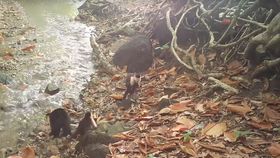


Researchers have discovered that one population of white-faced capuchin monkeys in Panama have entered the Stone Age. The monkeys have started using stone tools to break nuts and shellfish, making them the fourth type of primates to do so after us.
As reported in New Scientist, the group inhabits Jicarón island, a small island off the coast of Panama and part of the Coiba National Park. Three islands make up the national park, with capuchin monkeys on all three of them. However, only the monkeys on Jicarón have started using tools – and not all the capuchins at that. Only the males in a particular region of the island use them. A paper with the findings is currently available on BioArXiv.
“We were surprised that this behaviour appears to be geographically localised,” lead author Brendan Barrett at the Max Planck Institute for Ornithology told New Scientist.
The first report of this behavior in the park's monkeys dates back to 2004, when co-author Alicia Ibáñez noticed the monkeys using stone tools. Researchers went back in March 2017 and placed camera traps across the three islands to catch the monkeys in the act.
The team witnessed the male monkeys break coconuts, crabs, and snails. However, it is unclear why this behavior is not more spread out to other groups on the island. The researchers note that individual monkeys move between groups, so in theory the innovation should spread.
The team suggest that it is possible that entering the Stone Age has a chance component to it, rather than being an expected trajectory for primates. Perhaps, for example, a smarter-than-average individual began using the tools and the others copied him. Given limited food options, tools can increase their chance of survival.
The team hope that more research and further observations of these monkeys will help explain what is going on.
The white-faced capuchins are the second American species to enter the Stone Age. Another group of capuchins, found in South America, use stone tools and may have done so for 700 years. The other two species are macaques in Thailand and chimpanzees in West Africa.
[H/T: New Scientist]