Nature
 PUBLISHED
 1
1



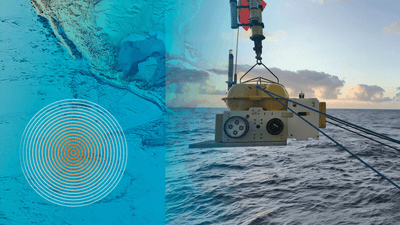


Deep in the Pacific, far away from the coast of Ecuador, there is a fascinating geological spot. It is known as the Gofar Fault, and for the last 30 years, it has been at the center of a mystery. Every 5 to 6 years, it experiences a magnitude 6 quake. An earthquake repeatedly hitting the same place with the same energy was unheard of, so it seemed that something peculiar must be going on. Finally, scientists have an answer.
The Gofar fault is situated between the Pacific tectonic plate and the Nazca tectonic plate. This is a type of transform fault where the two plates move horizontally past each other. They are shifting at a rate of 14 centimeters (5.5 inches) per year, roughly the rate of growth of your fingernails. But because these aren’t fingernails but massive slabs of rock, the movement accumulates a lot of energy, which is released as earthquakes.
For the Gofar Fault, the release appears to be impossibly regular, so researchers set out to understand how. The team conducted ocean floor experiments in 2008 and again between 2019 and 2022 to measure the detailed geological behavior before, during, and after the quakes. The data reveal the presence of “geological barrier” regions that can absorb the fault stress without producing enormous quakes.
“We’ve known these barriers existed for a long time, but the question has always been, what are they made of, and why do they keep stopping earthquakes so reliably, cycle after cycle?” seismologist Jianhua Gong at Indiana University Bloomington said in a statement.
The data taken two cycles – so 12 years – apart reveal the secret of these geological barriers. The instruments show that in the months and weeks ahead of major quakes, the barrier lit up with intense but small quakes. Tens of thousands were detected. Then after the big quake struck, the seismological activity around the barrier became almost completely quiet.
The team believes that the barriers are complex zones where the fault splits into multiple sideways strands, with offsets between them between 100 and 400 meters (109 to 437 yards). Seawater seeps deep inside the rock, and when a large quake hits, this causes the rock to “lock up”, creating an effective brake to the quake.
“These barriers are not just passive features of the landscape,” said Gong, who was a graduate student in the MIT-WHOI Joint Program during part of the research. “They are active, dynamic parts of the fault system, and understanding how they work changes how we think about earthquake limits on these faults.”
The Gofar fault is far from any population, so these regular quakes don’t affect people, but there are similar faults around the world that might. Understanding them is paramount to learn how quakes form and behave so we can protect populations from their impacts.
A paper describing these results was published in the journal Science.