Nature
 PUBLISHED
 1
1


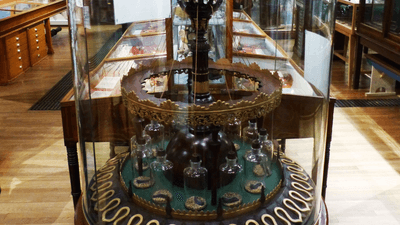


The Tempest Prognosticator would likely pull great ratings for weather reporters. Like a haunted carousel housing leeches in glass bottles, its inventor George Merryweather (don’t you just love nominative determinism?) believed it could warn of great storms. In truth, the leech barometer hasn’t been found to be all that reliable, but it sure is cooler than some modern attempts to get people excited about the weather.
The Tempest Prognosticator was invented in 1850 by Merryweather who was a physician and inventor from Whitby, England. As the honorary curator of the Whitby Literary And Philosophical Society’s Museum, it’s said he was inspired by a line from the poem Signs Of Rain by Edward Jenner, which spurred on his curious design.
“The leech disturbed is newly risen; Quite to the summit of his prison,” – Edward Jenner (1749-1823).
Merryweather started to work on ideas for his invention, initially given the more conservative title of “An Atmospheric Electromagnetic Telegraph, conducted by Animal Instinct”. Eventually, he settled on a design that placed a group of 12 leeches inside glass bottles, on top of which was a whalebone.
In the middle of the circular contraption was a bell surrounded by 12 hammers that would ring it when the whalebone was knocked out of the bottle neck by a climbing leech. The idea was that when low atmospheric pressure – a precursor to severe weather – disturbed the leeches, they would wriggle up in their bottles just like in Jenner’s poem.

As they wriggled up, they’d trigger the hammers, meaning a severe tempest (storm) was “prognosticated”. Merryweather reportedly referred to the leeches as his "jury of philosophical councilors".
So, did it ever work? According to a correspondence in the medical news section of Neglected Science by J Jeken et al., the Tempest Prognosticator successfully detected an oncoming and disastrous storm more than two days before it made ground.
"The disastrous storm of the month of October, 1850, was foretold by the Tempest Prognosticator, and communicated by letter to the president of the Whitby Philosophical Society, fifty-one hours and a half before it took place. We understand that Dr Merryweather intends to confine the manufacture of these instruments to the artisans of Whitby.- Illustrated London News.”
Merryweather wanted to demonstrate the Tempest Prognosticator at the Great Exhibition of 1851 and so its Indian temple-like design was inspired by Crystal Palace where the event would be held. Unfortunately, the original model from the exhibition was lost and despite having created several designs, the invention never took on.
People who aren’t fans of bloodsucking parasites might not be keen on the idea of keeping a bunch of weather-predicting leeches in their home, of course, but we think it’s pretty cool. Perhaps it’s a pity Merryweather wasn’t also inspired by another line from Jenner’s memorable poem:
“The frog has lost his yellow vest, and in a dingy suit is dressed.”
Now there’s a project we can all get behind.