Space and Physics
 PUBLISHED


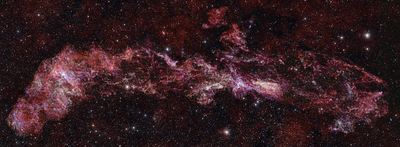


The most intensive study of the Central Molecular Zone (CMZ) in the Milky Way’s core has revealed the shapes sculpted by that intense environment out of the raw material for stars.
The supermassive black hole at the center of the galaxy is famous even to non-astronomers, but around it is an immense zone shaped by the black hole and the density of nearby stars, which no one has previously seen clearly. Our view of this region is almost entirely obstructed in visible light, but at longer wavelengths things are different. The Atacama Large Millimeter/submillimeter Array (ALMA) has used the power of 66 radio telescopes working together in one of the few places on Earth dry enough for these observations to create our most detailed picture yet.
“It’s a place of extremes, invisible to our eyes yet now revealed in extraordinary detail,” said Dr Ashley Barnes from the European Southern Observatory in a statement. “It is the only galactic nucleus close enough to Earth for us to study in such fine detail.”
For the first time, astronomers are getting a picture of how the whole region interacts, rather than looking at clouds in isolation.
The project goes under the name of ACES (ALMA CMZ Exploration Survey). “The gas that ACES is targeting is cold molecular gas – the raw fuel from which stars form and that ultimately powers them,” said Professor Christoph Federrath of the Australian National University.
Even at a distance of 27,000 light years, the 650-light-year-wide area ACES is exploring takes up 1.5 degrees of the sky, three times the width of the Moon. Wide angle telescopes like the Murchison Wide Field Array and the Vera Rubin Observatory are transforming astronomy, but ALMA normally studies tiny areas of the sky. ALMA created a mosaic of the largest area it has ever covered, stitched together from detailed images with a resolution less than a fifth of a light-year across.
ALMA collected so much data for ACES that even a preliminary analysis will be published as a series of six papers.
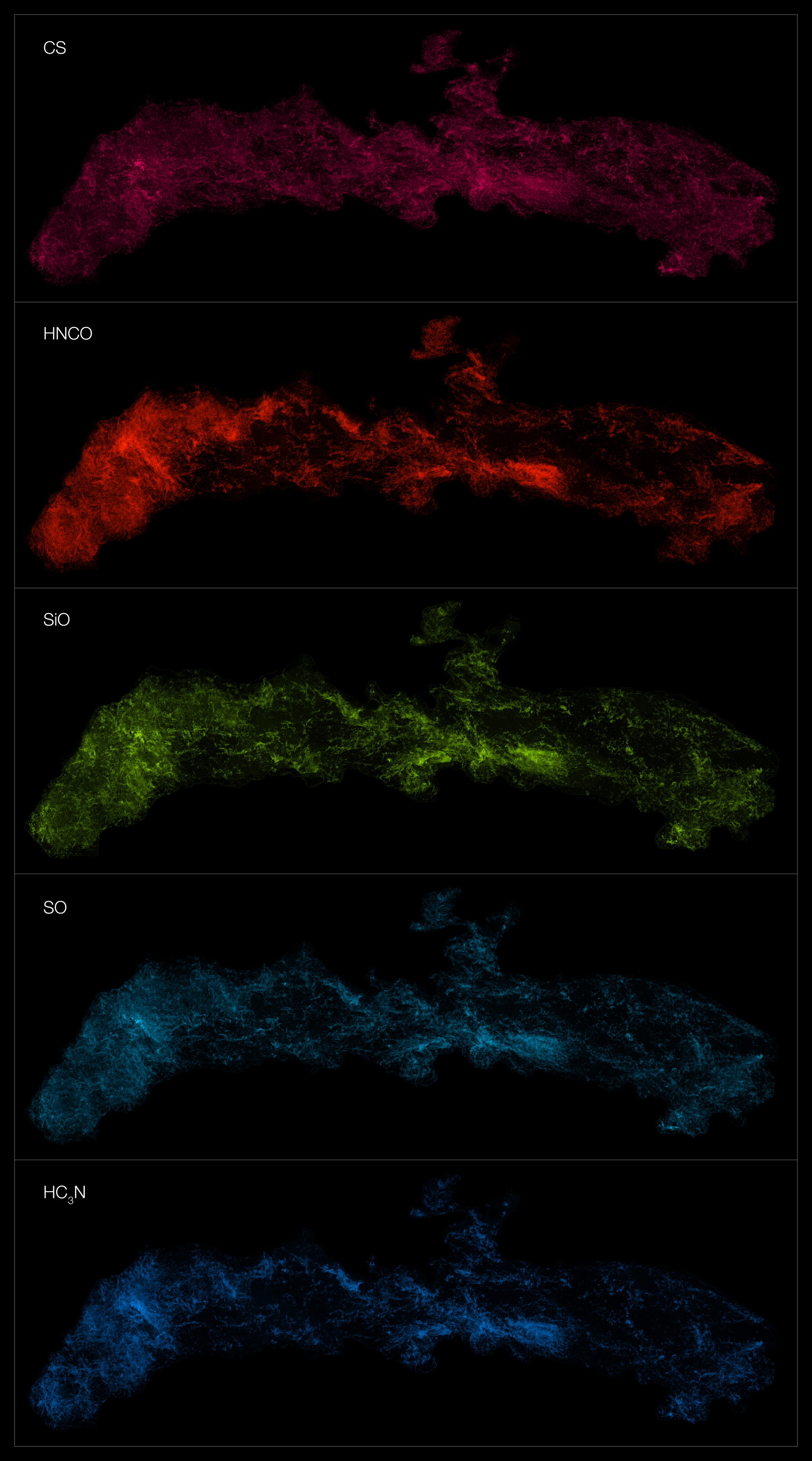
“A defining feature of all star-forming clouds is their highly turbulent, chaotic flows of gas and dust,” Federrath said. Nowhere else in the galaxy, however, are the forces driving those flows so powerful. In addition to the black hole itself, “The CMZ hosts some of the most massive stars in our galaxy – stars that live fast and die young in spectacular explosions called supernovae, or even hypernovae,” said Professor Steve Longmore of Liverpool John Moores University. Even when not exploding, these stars have ferocious stellar winds and blistering UV radiation.
Consequently, it’s no surprise that, in Federrath’s words, “Near the Galactic Centre, this turbulence becomes extreme, weaving a dense, tangled web of filaments that ultimately collapse to form new stars.”
Resolving how the multiple forces combine to create the turbulence ACES documented will answer some major questions in astrophysics, and quite likely open up new ones. “By combining cutting-edge supercomputer simulations with observational datasets like ACES, we can finally begin to unravel the mysteries of the extreme, chaotic conditions under which stars are born,” Federrath said.
“We believe the region shares many features with galaxies in the early Universe, where stars were forming in chaotic, extreme environments,” Longmore said in a different statement.
One of the first things the ACES team hope to resolve is why stars are forming less efficiently in the CMZ than models predict. Over the last 5-10 million years, the region has added new stars at a rate of 0.1 stellar mass per year, based on the photons emitted. Models predict the rate should be five to 10 times higher.
Although the data will be analyzed for years to come, a ring of shocked material with the mass of a million Suns has already been identified. The authors attribute this to “a single very energetic explosion, plausibly a hypernova.” They’ve also found something they have dubbed the Millimeter Ultra-Broad Line Object (MUBLO) that doesn’t look like anything we have seen before. As the name suggests, so far no one knows what it is.
The six papers have been accepted for publication in Monthly Notices of the Royal Astronomical Society and are available as preprints on the ArXiv, starting with an overview.