Nature
 PUBLISHED


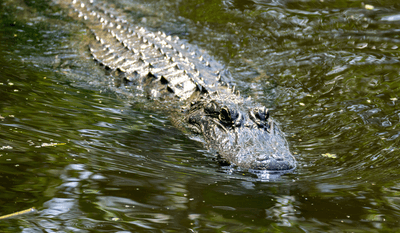


Native American artifacts, perhaps dating back up to 8,000 years old, were once recovered in the belly of a giant alligator in Mississippi, though the exact nature of one of them remains a mystery to this day.
The discovery was made back in September 2021 by Red Antler Processing, a wild game processing facility located in Yazoo City, Mississippi. Posting the discovery on social media, the team said: “We have been cutting into a few big gators to see what was in their stomach, every one so far has had something cool in it. The 13 foot 5 inch [4-meter] gator brought in by John Hamilton today, produced the shock of the year!!”
The images got passed on to James Starnes, Director of Surface Geology and Surface Mapping for the Mississippi Department of Environmental Quality, who has a keen interest in local archeology. Speaking to the Mississippi Clarion Ledger, he identified one of the objects as an atlatl dart point, a sharpened stone tip hafted to the end of a spear-like shaft and hurled with a throwing lever.
While radiocarbon dating would be needed to confirm the age, Starnes suspected it was crafted somewhere between 5,000 and 6,000 BCE, meaning it could be up to 8,000 years old.
“That is the latter part of the Early Archaic and early part of the Middle Archaic," Starnes told the local newspaper. "How the base is made is real tell-tale in estimating the time period."
The second object is far more mysterious. Starnes identified it as a plummet, a smoothed, teardrop-shaped stone that has puzzled archaeologists for decades. Thousands have been recovered across North America, but their purpose remains unknown. Some believe they were used in hunting or fishing; others think they held personal or spiritual significance.
"The plummets, we really have no idea what they were used for," Starnes said. "These things had some significance, but we have no idea. We can only guess."
But what are 8,000-year-old relics doing inside an alligator anyway? Shane Smith, owner of Red Antler Processing, admitted his first fear was that the gator had eaten a Native American hunter, although that notion was quickly put to rest.
The most likely explanation is far simpler: alligators will pretty much eat anything, including rocks. Crocodilians are known to swallow stones deliberately. They might do this to obtain minerals like calcium, aid digestion, or rid their intestines of parasites. Alternatively, there’s some good evidence they do it to manage their buoyancy, a very important skill if you’re a river-lurking predator.
It's perfectly plausible that the alligator chomped down these stone objects, blissfully unaware that they had been modified by humans long, long ago.