Nature
 PUBLISHED


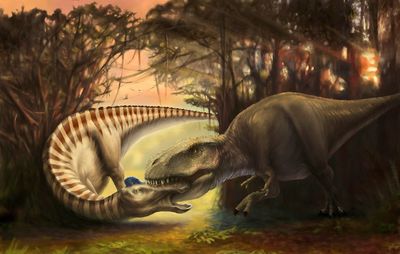


Fossils may give us an idea of what dinosaurs looked like – they may even give us clues about how they lived – but very rarely do they show us precisely how they died. One notable exception is currently on display at Montana State University’s Museum of the Rockies: a nearly complete Edmontosaurus skull… with a Tyrannosaurus tooth lodged in its face.
“Although bite marks on bones are relatively common, finding an embedded tooth is extremely rare,” said Taia Wyenberg-Henzler, a doctoral student at the University of Alberta, in a statement. It’s a find that allows for a “kind of […] Cretaceous crime scene [investigation],” the researcher added. “An embedded tooth, particularly in a skull […] gives you the identity of not only who was bitten but also who did the biting.”
While the Edmontosaurus skull has been in the archives for a while – it was found more than 20 years ago, in the Hell Creek Formation of eastern Montana – it’s a new analysis by Wyenberg-Henzler and Museum of the Rockies’ Curator of Paleontology John Scannella that’s making this week’s headlines. They used computed tomography (CT) scans to measure exactly how deep and hard the bite went in; they also confirmed, by comparing it against all the other teeth found in the formation, that the tooth came from a Tyrannosaurus.
“A fossil like this is extra exciting because it captures a behavior: a tyrannosaur biting into this duckbill’s face,” Scannella explained. “The skull shows no signs of healing around the tyrannosaur tooth, so it may have already been dead when it was bitten, or it may be dead because it was bitten.”
Indeed, exactly how the iconic T. rex used to find its meals has long been debated – despite its gigantic size and fearsome jaws, the idea that it was actually a scavenger rather than a hunter was first proposed more than 100 years ago. Most probably, it was a mix of both: primarily a predator, but if it stumbled across a freshly slain Triceratops tartare, well, no harm, no foul.
That may have been the case for the Hell Creek Edmontosaurus too – that it died and was in short order found by a hungry tyrannosaur. But overall, the evidence points to a much grislier story, said Wyenberg-Henzler.
“Looking at the way the tooth is embedded in the nose of the Edmontosaurus suggests that it met its attacker face-to-face,” she explained, and “the amount of force necessary for a tooth to have become broken off in bone also points to the use of deadly force.
It all implies “an animal that was killed by a predator,” she said. “For me, this paints a terrifying picture of the last moments of this Edmontosaurus.”
The study is published in the journal PeerJ.

 2
2