Space and Physics
 PUBLISHED


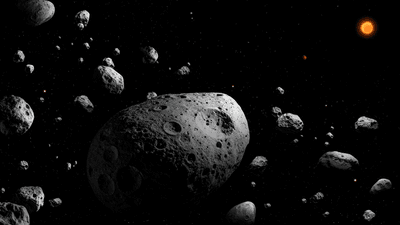


The first batch of asteroids detected by the Vera C. Rubin Observatory includes one amazing oddball, with a rotation rate faster than anything we have seen before. It’s not an isolated outlier, however, with 18 others in the new collection also turning remarkably fast.
Proponents of the Rubin Observatory promised that its wide field of view (9.6 square degrees) and 3.2-gigapixel Legacy Survey of Space and Time (LSST) camera would transform the search for objects moving through the Solar System. The most obvious practical application was to spot any that might threaten Earth. More recently, the excitement around comet 3I/ATLAS has turned the focus to the interstellar visitors it will spot.
Even objects that fit neither of those categories can be interesting, however, and astronomers are currently picking through more than 2,000 whose data was released in June 2025. So far, the standout is 2025 MN45, which is 710 meters (0.4 miles) long and has a day that lasts just 1.88 minutes. There are asteroids that rotate in seconds, but these are tiny.
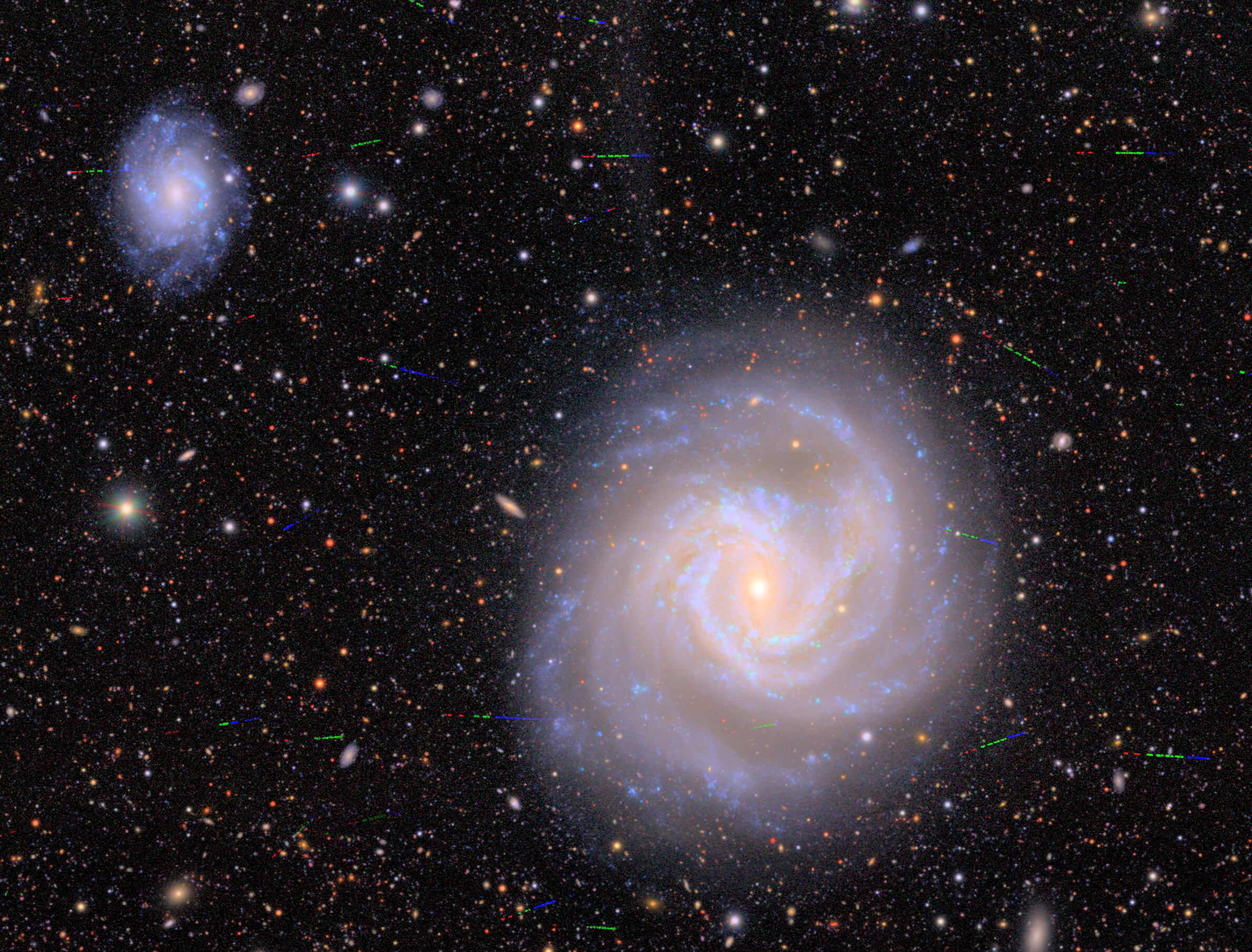
Just as the planets’ rotation rates vary between Jupiter’s 10 hours and Venus’s 243 days, asteroids have wide variation in the time they take to spin on their axis. Although it is not always possible to tell why an object turns at the rate it does, it is thought that very fast rotations are the product of a recent collision at the right angle and location.
We now know that most asteroids are not strongly bound together, referred to as “rubble piles”; if they spin too fast, the centrifugal force will throw some of their dust off or destroy them entirely. It is thought that most main belt asteroids more than 150 meters (500 feet) wide can’t have rotation periods shorter than 2.2 hours without destroying themselves this way, and Trojans need an even longer period.
Consequently, any very fast spinning asteroid is of interest, because we know it must be an exception, tightly bonded together.
Although we can’t see most asteroids closely enough to observe features on them appearing and disappearing as they turn, there is another way to measure the spin. Only the largest few asteroids, such as Ceres, are nearly spherical. The rest have irregular shapes, causing them to brighten and fade as they turn, depending on the surface area catching the Sun’s light.
In many cases, the objects the Rubin Observatory picked up during its test phase in April/May are too faint to measure their rotation this way. Others are turning so slowly we will need many more days of observations to track the changes. Just a few hours, however, were all that was needed to gather data on super-fast-rotators (5-130 minutes) and ultra-fast-rotators (<5 minutes).
A team led by Dr Sarah Greenstreet of NOIRLab identified 16 in the first category and three in the second, among 76 for which reliable rotation rates could be measured. All are at least 90 meters (295 feet) long. 2025 MN45 has set the record for the fastest rotation of a known object more than 500 meters (1,650 feet) wide, but it only narrowly beats out another Rubin discovery – 2025 MJ71, which takes 1.92 minutes to turn but is smaller.
“Clearly, this asteroid must be made of material that has very high strength in order to keep it in one piece as it spins so rapidly,” Greenstreet said in a statement. “We calculate that it would need a cohesive strength similar to that of solid rock. This is somewhat surprising since most asteroids are believed to be what we call ‘rubble pile’ asteroids, which means they are made of many, many small pieces of rock and debris that coalesced under gravity during Solar System formation or subsequent collisions.”
The finding is particularly intriguing because prior to the Rubin data drop, most of the known fastest spinners were near-Earth objects, with those in the asteroid belt turning at a more stately pace. However, all but three of those in this sample are in the main belt, with two slightly beyond it. That will force a rethink of the population statistics and evolution of main belt asteroids.
The rapid spin rate of the comet on course for Earth in the film Deep Impact became a major plot point as to why it is hard to stop, and that was hours, not minutes. Fortunately, none of these objects are going to be a threat for a very long time, if ever.
“We have known for years that Rubin would act as a discovery machine for the Universe, and we are already seeing the unique power of combining the LSST Camera with Rubin’s incredible speed. Together, Rubin can take an image every 40 seconds,” said Professor Aaron Roodman of the SLAC National Accelerator Laboratory. “The ability to find thousands of new asteroids in such a short period of time, and learn so much about them, is a window into what will be uncovered during the 10-year survey.”
“NSF–DOE Rubin Observatory will find things that no one even knew to look for,” added the National Science Foundation’s Professor Luca Rizzi.
The study is published open access in The Astrophysical Journal Letters.

 1
1