


 Nature
 PUBLISHED


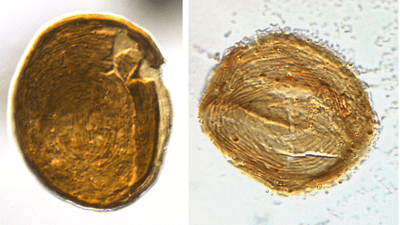


The secret identity of a curious group of fossils has been revealed after palaeontologists sifted through almost 500 papers and got to watch a world-first microscope observation on YouTube. The fossils look a bit like a fingerprint that’s sloughed off, but they are, in fact, the encysted remains of a group of organisms that are neither plant nor animal.
The fossils have been misidentified over the years due to strange lines or “ribs” that mark their surface, making them look a bit like a fingerprint. Unsure of what to do with them, scientists slapped on the label Pseudoschizaea, imagining they were some kind of shell, but new research has pointed to an alternative explanation.
An international team realized they could be looking at euglenoids, a group of single-celled protists that are neither plant nor animal. Like plants, euglenoids photosynthesize, but like animals, they also eat. They’re thought to date back around a billion years to the start of the eukaryotic branch of the tree of life, but we haven’t found many of them in the fossil record.
To test if they were onto something, the team sifted through hundreds of sources on animals resembling Pseudoschizaea, covering specimens that dated back almost 500,000 years in the fossil record. The theory was that the fossils may be encysted euglenoids, which is a magic trick they use to survive harsh conditions by buckling down into a little ball. A skill that could explain why they’ve persisted for such a long time on Earth.
"Perhaps related to their capabilities to encyst, these organisms have endured and survived every major extinction on the planet," said Bas van de Schootbrugge, then at the Goethe University in Frankfurt am Main, in a statement. "Unlike the behemoths that were done in by volcanoes and asteroids, these tiny creatures have weathered it all."
The only problem was that nobody to date had ever been able to observe a euglenoid encysting in a lab, but then along came microscopy enthusiast Fabian Weston from Sydney, Australia. His footage of water taken from a nearby pond in New South Wales posted to YouTube ended up capturing the moment the Euglena balled up and formed cysts with little lines similar to those seen in our mystery fossils.
“Unwittingly, Fabian provided a key piece of evidence,” said Paul Strother from Boston College. “He is probably the only person on the planet to have witnessed Euglena encyst under a microscope.”
The findings enabled the team to establish a timeline for euglenoids that goes back 400 million years, pieced together with the help of 200-million-year-old fossils and pond sediments from the Triassic-Jurassic boundary, as well as extant euglenoids living and encysting today.
“This opens the door for recognizing even older examples, for example from Precambrian records that go back to the very root of the eukaryotic tree of life,” concluded Strother.
“Now that we know which organisms produced those cysts, we can also use them for paleo-environmental interpretations. Their abundance around two of the largest mass-extinction events of the past 600 million years is a tell-tale sign of some major upheavals on the continents related to increased precipitation under extreme greenhouse climate conditions.”
The study is published in the journal Review of Palaeobotany and Palynology.

 1
1