Space and Physics
 PUBLISHED



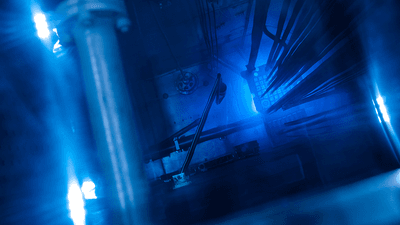


Scientists working on the Askaryan Radio Array, an extremely large neutrino detector buried around 200 meters (656 feet) under the Antarctic ice, have reported 13 detections originating not from neutrinos – but from cosmic rays.
Neutrinos are incredibly difficult to detect and are sometimes called "ghost particles" for their habit of almost never interacting with matter, and then only through the weak nuclear force and gravity. But scientists have developed some tricks for spotting them, such as exploiting an effect known as Cherenkov radiation, which occurs when particles travel faster through a medium than light.
The speed of light in a vacuum is the absolute speed limit of the universe. Nothing will ever go faster than 299,792 kilometers per second (186,282 miles per second) because it would require an infinite amount of energy to do so.
That doesn't mean light can't be beaten in a particular medium, however. In water, for example, light is slowed down to an embarrassing 225,000 kilometers per second (139,808 miles per second).
When a particle breaks this slowed speed of light within a medium, it produces a flash of blue Cherenkov radiation, which neutrino detectors such as IceCube and KM3NeT have looked for in the ice and oceans, respectively, to great effect.
There is a problem with these methods, however, in that we may be missing the highest-energy neutrinos. As these are believed to be extremely rare, detecting them would require Cherenkov detectors that span hundreds of cubic kilometers.
But this is where the Askaryan Radio Array has an advantage: it isn’t looking for Cherenkov radiation; it’s looking for Askaryan radiation, first described by particle physicist Gurgen Askaryan.
"First predicted by Askaryan in 1962, this radiation has its origin in the netnegative charge generated in the moving shower front as Compton, Bhabha, and Møller scattering draws electrons from the surrounding material into the shower and positrons continuously annihilate," the team explains in their paper.
"This radio frequency (rf) signature was first observed and studied in a series of experiments at particle accelerators in the 2000s, which identified the Askaryan effect as the relevant emission mechanism for cascades in dense dielectrics."
Askaryan radiation has been detected before in air from showers produced by cosmic rays, and theoretical studies have shown it could also be detected in ice. Cosmic rays are usually subatomic particles like protons or atomic nuclei.
During 208 days of observations in 2019 using one of ARA’s five stations, 13 events of unknown origin were detected underneath the ice.
“It was already hypothesized that some of those events could be due to cosmic rays impacting the ice sheet,” team member Philipp Windischhofer at the University of Chicago explained to Physics, however this was unconfirmed until recent simulation techniques became available to the team.
Now, separating the signal from potential sources of noise, the team reports that these events were produced by high-energy cosmic rays, with a confidence of 5.1 sigma, the gold standard for discoveries in physics.
While the goal is to detect neutrinos rather than cosmic rays, the two radio signals are expected to look very similar. Should they see the same kinds of signals further beneath the surface, where neutrinos can penetrate but cosmic rays can't, we may get our first neutrino detection using radio waves, and a method of looking for the highest-energy neutrinos we have seen so far.
The study is published in Physical Review Letters.