Nature
 PUBLISHED
 1
1


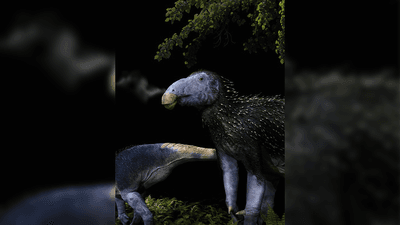


A species of iguanodontian dinosaur has been revealed to have been covered in spines more like those of some mammals than anything seen before in dinosaurs. Since the only evidence we have of this sort of protection comes from a juvenile, we can’t rule out the possibility that the species put away its quills when it grew up, but it would have been a puzzling move.
Life was hard for Cretaceous herbivores, and a defense mechanism could be the difference between grandchildren and death. So it’s not surprising that evolution experimented with plenty of approaches. Ankylosaurs’ tank-like armor and stegosaurs’ sharp plates are famous, but there were probably other defenses we don’t know about because they didn’t fossilize well.
Under more typical conditions, a fossil found at Lamagou in Liaoning Province might have looked like plenty of other members of the widespread Iguanodontia group, since its bones and teeth don’t look unusual. Fortunately, however, this is a rare case where the environment in which the specimen died also preserved its skin, and that is indeed remarkable.
Some Iguanodontia skin has been preserved, but mostly from late Cretaceous hadrosaurids. Earlier in the dinosaurs’ reign, the best that had been available were the imprints of small patches of scales, so when a team led by Jiandong Huang of Anhui Geological Museum found an astonishingly preserved imprint in the 125 million-year-old Yixian Formation, they knew they had something special.
The new species has been named Haolong dongi, with the genus translating to “spiny dragon” in Chinese. The species name honors Dong Zhiming, a leading paleontologist who died in 2024.
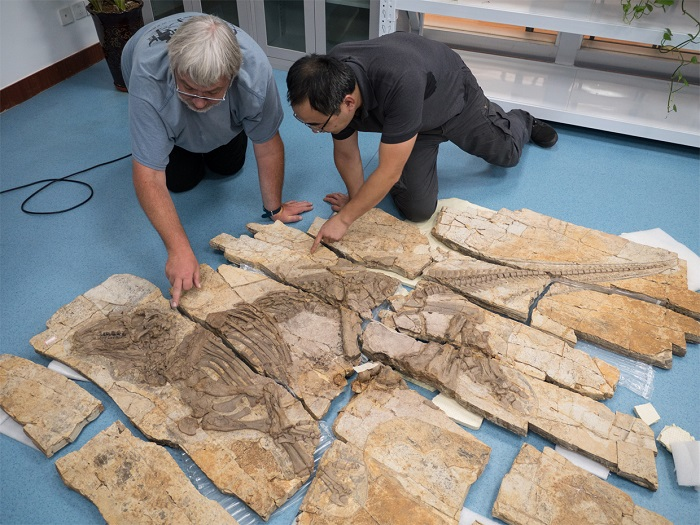
The specimen was 2.45 meters (8 feet) long from snout to tail, but its vertebrae were not fused, indicating it was still young and growing. Although we can’t know how big it had the potential to grow, the authors point to some local species that might have been relatives, which grew to 3 meters (10 feet) and 5-5.5 meters (16-18 feet) respectively. Meanwhile, European iguanodontians of the same time were growing much larger.
The skin reveals two types of scales that resemble those of many modern reptiles, but differ from preserved hadrosaurids in overlapping on the tail. The body scales do not overlap, making them more similar to other dinosaurs.
More significantly, the scales are mixed with spikes that are hollow and almost cylindrical in shape. Although some non-avian dinosaurs developed protofeathers, and certain lizards use scaly spines for protection, these appear to be so different from each other that Huang’s team think they evolved independently.
Most of the spines are very small, just 2-3 millimeters (0.08-0.12 inches), but these are mixed with longer ones, with the longest preserved spike being 44.2 millimeters (1.7 inches) long and 7.8 millimeters (0.3 inches) wide at the base. Despite this large difference in size, they all have the same simple shape. Spiky mammals’ defenses have a similar composition to hair; here, it is the material that formed the scales that has been pressed into a second role making up the spines.
Unusual body formations in extinct species are usually attributed to: protection against predators, mate attraction, and thermoregulation (maintaining or shedding heat). In this case, the authors favor the first explanation, although they say that the climate of the location possibly made keeping warm a secondary benefit. They also speculate that the spines were used to sense the environment, as snakes use bristles to pick up vibrations.
Most of the known predators H. dongi would have had to face were relatively small, with mouths vulnerable to spikes like these. “These defences did not necessarily provide impenetrable protection against theropod teeth and claws, but they made the prey more difficult and time-consuming to kill and ingest and consequently reduced the likelihood of successful ingestion,” the authors write. The larger spikes may also have served to warn off rivals or attract mates.
The study is published in Nature Ecology & Evolution.