Nature
 PUBLISHED


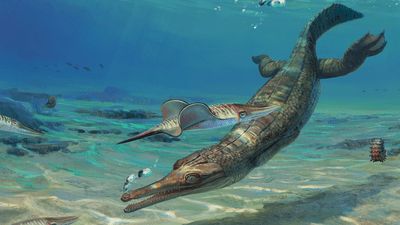


An epic dig along the UK’s Jurassic Coast has uncovered a remarkable find: an ancient crocodile-like creature that would’ve looked a little like the modern gharial. It’s the most complete specimen of its kind, consisting of a partial skull, backbone and a few limbs, meaning scientists were able to name it – something that’s not yet been possible in the thalattosuchian specimens dating from the Pliensbachian period that occurred around 185 million years ago.
Beyond bringing Turnersuchus hingleyae into scientific record, the find lifted from the Charmouth Mudstone Formation helps fill a gap in the fossil record, telling us that these thalattosuchians were swooshing through the seas alongside other crocodyliforms from the end of the Triassic period. This pushes back our understanding of when Turnersuchus lived by around 15 million years, though there remains a ghost lineage that we've yet to find in Triassic-era substrate.
“We should now expect to find more thalattosuchians of the same age as Turnersuchus as well as older,” said co-author Dr. Eric Wilberg, Assistant Professor at the Department of Anatomical Sciences, at Stony Brook University, in a statement.
“In fact, during the publication of our paper, another paper was published describing a thalattosuchian skull discovered in the roof of a cave in Morocco from the Hettangian/Sinemurian (the time periods preceding the Pliensbachian where Turnersuchus was found), which corroborates this idea.”
Yes, they found a croc in the ceiling of the Chaara cave, a natural karst cavity that sits in the Middle Atlas of Morocco. Unfortunately, the odd location of the find puts it in dolomitic limestone, meaning retrieving it from the rock wasn’t possible, but researchers were able to build a 3D model of the remains using photogrammetric study.
This find, like T. hingleyae, taught us new things about these animals, as the oldest known African thalattosuchian.
“The new fossil described herein confirms that the paleogeographic distribution of thalattosuchians has been widely distributed since the earliest Jurassic,” the researchers highlighted, as it demonstrates these animals must’ve been alive and kicking during the Triassic to have spread so far come the Jurassic. “In addition, this discovery will enrich the natural paleontological heritage the edge of the Tazzeka National Park and will also enrich the number of specimens of thalattosuchians discovered in Africa.”
It seems then that if you were to go swimming in Earth’s oceans back in the Triassic, you may well have come across these animals that are sometimes referred to as “sea crocodiles”, though they don’t actually sit within the Crocodylia order. As their relatives, however, they would’ve looked quite similar, with modified limbs for flippers, a narrow snout, and a shark-like tail fin.
“I expect we will continue to find more older thalattosuchians and their relatives,” said Wilberg. “Our analyses suggest that thalattosuchians likely first appeared in the Triassic and survived the end-Triassic mass extinction.”
The Jurassic Coast find was published in the Journal Of Vertebrate Paleontology.