Nature
 PUBLISHED
 1
1


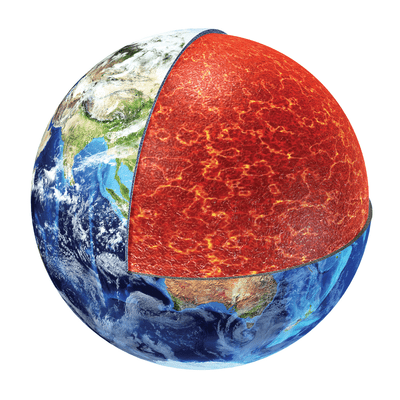


Scientists have discovered a “new layer” of Earth’s interior that’s made of partially molten rock, gently oozing around some 160 kilometers (100 miles) beneath our feet. Located just under Earth’s crust, knowledge of this zone might help to deepen our understanding of how colossal tectonic plates drift through the mantle and form the shape of our planet’s continents.
Portions of this layer of partly molten rock have previously been identified and studied by scientists. However, in a new study, researchers from the University of Texas at Austin have managed to reveal the global extent of the layer.
Pictured below in speckled red marks, the zone described in the new study is a global layer of partial melt found in the asthenosphere, a region of the rocky upper mantle of Earth that sits below the tectonic plates. The asthenosphere is a bit like a superheated boundary just under the crust, which influences the movement of plate tectonics through the mantle.
Unlike much of the mostly-solid mantle, this upper portion of the asthenosphere is made of partially melted rock that oozes like super-sludgy honey.
.png "Earth's layers with a global layer of partial melt (shown in speckled red).")
The idea to study the new layer – referred to as the asthenospheric low-seismic-velocity zone – came after the team was studying seismic images of the upper mantle beneath present-day Turkey, which suggested there were patches of partly molten rock under the crust.
After putting together a global map of the asthenosphere, they realized this wasn’t a strange anomaly under Turkey, but a common feature found around the world, appearing on seismic readings wherever the asthenosphere was hottest.
In the new research, the researchers looked deeper into the nature of this global layer of partial melt and attempted to understand why it is soft, which is not fully understood.
“When we think about something melting, we intuitively think that the melt must play a big role in the material’s viscosity,” Junlin Hua, lead researcher and a postdoctoral fellow at UT’s Jackson School of Geosciences, said in a statement. “But what we found is that even where the melt fraction is quite high, its effect on mantle flow is very minor.”
Furthermore, the work suggests that the melt layer has a little-to-no influence on the motion of the tectonic plates.
“We can’t rule out that locally melt doesn’t matter,” added Thorsten Becker, study co-author and professor who designs geodynamic models of the Earth at the Jackson School’s University of Texas Institute for Geophysics. “But I think it drives us to see these observations of melt as a marker of what’s going on in the Earth, and not necessarily an active contribution to anything.”
The new study was published in the journal Nature Geoscience.