Space and Physics
 PUBLISHED



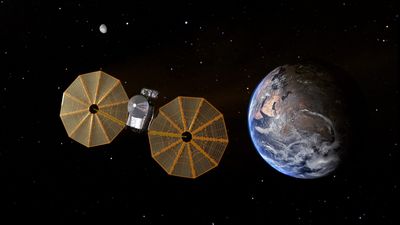


NASA’s Lucy is a record-breaking mission that will study a record-breaking 11 asteroids across the Solar System. Three of them are already under its belt; it passed close to asteroid Dinkinesh last year and discovered a double moon around the small object. Next year, it will visit asteroid Donaldjohanson before flying towards the Trojan asteroids, rocks that share their orbits with Jupiter. To do that, it will need a little help from Earth.
The spacecraft is rapidly approaching our planet at high speed and will use Earth’s gravitational pull to gain a fair bit of velocity. On December 13 (this Friday), it will reach a point 350 kilometers (217 miles) from the surface of the planet – that is closer than the typical orbit of the International Space Station.
The encounter will boost Lucy's velocity by 7.2 kilometers (4.5 miles) per second with respect to the Sun. If you want to see it streak across the sky, the team at the Virtual Telescope Project has got you covered.
After visiting Donaldjohanson, Lucy will reach the first group of Trojans – the ones preceding Jupiter in its orbit – in the summer of 2027. First, it will visit Eurybates and its moon on August 12; the following month will be a chance for it to get a closer look at Polymele and its satellite. Six months later, on April 18, 2028, it will be the turn of Leucus and in November of the same year, Orus.
Lucy will then fly back to Earth, where a more distant flyby will send it toward the Trojans that follow Jupiter, set to encounter the binary asteroid Patroclus–Menoetius on March 2, 2033.
The Trojans are believed to be unaltered building blocks of the Solar System and have been called its "fossils" – that’s why the spacecraft is called Lucy.
The name is shared with the iconic human ancestor Lucy, whose discovery revolutionized palaeontology. The fossil, in turn, is named after Lucy in the Sky with Diamonds, the famous Beatles song. Lucy’s first target asteroid, Dinkinesh, is named after the Ethiopian name for the Lucy fossil, which translates to "you are marvelous."