Nature
 PUBLISHED
 1
1





What would you like to be remembered for in 300 million years? Your jokes? Your charitable contributions? How about your butthole?
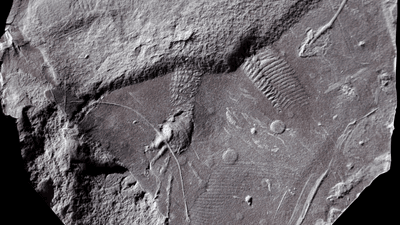
That appears to be the fate of a reptile that stopped for a rest in what’s now known as the Thuringian Forest in central Germany between 298 and 299 million years ago. A trace fossil retrieved from the region shows the remarkably detailed impression of the creature's back leg and tail, complete with what appears to be an imprint of its genitals.
The animal is thought to have belonged to an early reptile group that sits on the stem lineage of lizards. Like lizards alive today, it would have had a cloaca – a kind of one-hole-does-it-all solution to mating and excreting.
It seems weird to us, but we’re actually the outliers. Only placental mammals bother having separate openings for each job, but dinosaurs, birds, reptiles, amphibians, and cartilaginous fish all opted for the cloaca.
It’s thought such a cloaca may be responsible for a narrow, slit-shaped impression near the base of the tail imprint. If confirmed, it’s a fascinating discovery for several reasons.
First, we almost never find evidence of cloacas in the fossil record, but they can teach us a lot about ancient behaviors, including how dinosaurs had sex. There is one remarkable example preserved in the fossil of a Psittacosaurus discovered in northwestern China that today is on display at the Senckenberg Museum of Natural History in Frankfurt, Germany.
That cloaca dates back 120 million years, but it is a spring chicken compared with our ~300-million-year-old reptile. So, what’s the verdict?
Well, that’s the other fascinating thing. They’re really quite different. If the imprint we’re seeing is indeed a cloaca, then it’s oriented differently from that of dinosaurs and crocodiles, and more closely resembles the cloacas of modern lizards, turtles, and snakes.
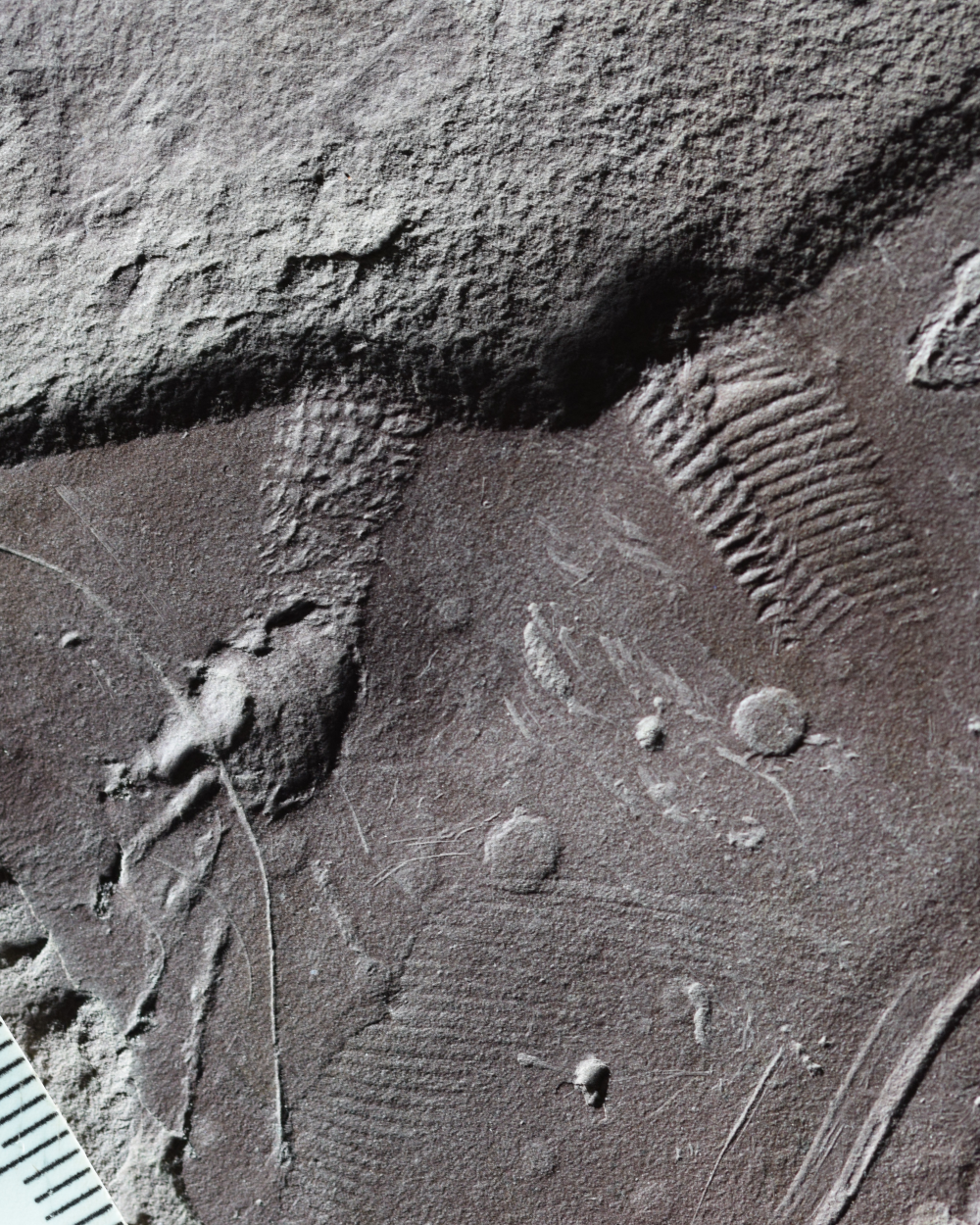
Though we don’t know exactly what kind of animal made them, the trackmaker is thought to be a stem reptile and the fossils have been given the ichnospecies name Cabarzichnus pulchrus. An ichnospecies name is assigned to fossil records of lifeforms' movements, rather than the lifeforms themselves.
The imprint marks a significant find for palaeontologists, not only because it's a world record for the oldest impression of reptile skin, but also because it provides an unexpected window into the evolution of ancient animals.
“Such soft tissue structures are extremely rare in the fossil record — and the further back we look in Earth’s history, the more exceptional they become,” explained Dr Lorenzo Marchetti in a release. “The traces from the Thuringian Forest open new perspectives on the early development of reptiles and their skin structures.”
“Trace fossils are far more than simple footprints. They preserve anatomical details that would otherwise be completely lost and play a key role in improving our understanding of the evolution of early terrestrial vertebrates.”
Wondering how it’s even possible for trace fossils like this to endure for hundreds of millions of years? Let us walk you through the fascinating study of ichnology.
The study is published in the journal Current Biology.
Correction: An earlier version of this article incorrectly stated that Cabarzichnus pulchrus was a species name rather than an ichnospecies name.