Space and Physics
 PUBLISHED



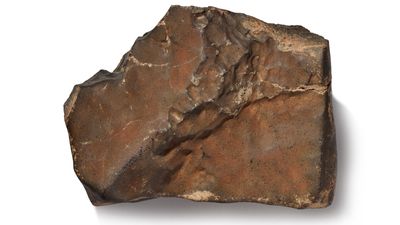


An exceptional celestial finding is about to go up for auction at Sotheby's this month. Meteorite NWA 16788 doesn’t have the catchiest name but it will soon be famous, as it is likely to become the “most valuable” meteorite in the world once it does; the estimated sale price is $2-4 million. At 24.5 kilograms (54 pounds), it's the largest ever Martian meteorite ever found.
The rock was found by a meteorite hunter in Niger’s remote Agadez region on November 16, 2023. It is officially the largest known Mars meteorite, at 70 percent larger than the previous record holder, which makes it pretty unusual.
Around 400 Martian meteorites are known worldwide, and most of them are in small bits. NWA 16788 is so big that by itself, it accounts for 6.5 percent of all the Martian material present on Earth. Out of all known meteorites, only 1 percent are known to have come from Mars.
 (1).jpg "Detailed view of the meteorite showing the curved surface, like sandy dunes being turned into rock.")
NWA 16788 is thought to have formed when an asteroid impacted the Red Planet, throwing material into orbit. The meteorite has the distinctive rust hue of Mars, but the evidence of its origin comes from the presence of minerals in its body that have been turned to glass. The descent into Earth’s atmosphere was also not easy, showing a fusion crust on its surface. That said, you do not need a catastrophic impact to be launched into space from Mars.
The meteorite is going up for auction on July 16 at Sotheby’s Natural History sale in New York, and it is estimated to reach a price between $2-4 million when it is sold. IFLScience contacted Sotheby’s to ask how the value of such an object is estimated but has not had a reply at time of writing.
"NWA 16788 is a discovery of extraordinary significance — the largest Martian meteorite ever found on Earth, and the most valuable of its kind ever offered at auction. Weathered by its journey through space and time, its immense size and unmistakable red color sets it apart as a once-in-a-generation find," Cassandra Hatton, Vice Chairman of Sotheby’s Science & Natural History, said in a statement sent to IFLScience.
"This remarkable meteorite provides a tangible connection to the red planet — our celestial neighbor that has long captured the human imagination."
There are concerns that a private sale would remove the ability for scientists to study this rare meteorite or for the public to be able to see and appreciate it. Though it hasn't reached the furore surrounding Apex the stegosaurus, which at $44.6 million became the most expensive fossil ever sold when it went up for auction at Sotheby's in July last year. Luckily, Apex ended up being permanently lent to the American Museum of Natural History. In this case, a reference sample of NWA 16788 has been saved at the Purple Mountain Observatory in China.
The meteorite was exhibited publicly in Italy at the Italian Space Agency in Rome during the 2024 European Researchers’ Night and at a private gallery in Arezzo, Tuscany. Between July 8 and 15, it can be seen at Sotheby’s New York before it goes to auction. Whether it will be seen again after that remains unknown.