


 Space and Physics
 PUBLISHED


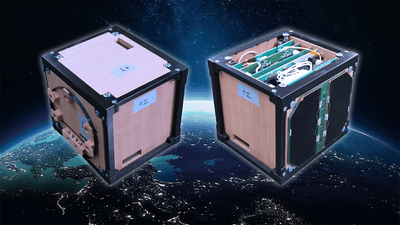


The world's first wooden satellite has been successfully launched into space and arrived at the International Space Station (ISS). Soon, it will be released into an orbit around 400 kilometers (250 miles) above the Earth.
Space around our planet is getting quite full. We are a messy species, and low-Earth orbit is apparently no exception to our "we'll clean up later" rule. One concern about the debris is that it could cause the "Kessler Effect" (or Kessler Syndrome). Simply put, the Kessler Effect is where a single event (such as an explosion of a satellite) in low-Earth orbit creates a chain reaction, as debris destroys other objects in orbit. Should this happen, the debris could keep colliding with other objects, potentially causing communication problems and leaving areas of space inaccessible to spacecraft.
Essentially, it could end up like the film Gravity, but with less George Clooney doing great eyebrow work and more "Hey, what happened to my GPS?". At worst, some speculate it could essentially trap us here on Earth, unable to leave.
To combat space junk, space agencies around the world are working on ways to capture space debris and gently nudge it into Earth's atmosphere to burn it up safely. But even with planned deorbits, there is a little risk to people, animals, plants, and property down below.
One idea to tackle the space junk problem is to make satellites themselves more sustainable. Researchers at Kyoto University together and the logging company Sumitomo Forestry are attempting to do this with their satellite LignoSat, named after the Latin word for wood.
Now on the ISS, LingoSat will soon be put to the test as it is launched into orbit, where instruments on board will monitor how the wooden structure holds up in the harsh conditions of space.
"Early 1900s airplanes were made of wood," Kyoto University forest science professor Koji Murata told Reuters. "A wooden satellite should be feasible, too."
Due to a lack of water and oxygen in space, wood should be a lot more durable there. Earlier tests, where wood samples were subjected to space conditions on the ISS for 10 months, looked promising, with little deterioration of the material.
But the real advantage is that they will burn up quite quickly in the atmosphere at the end of their operational life. Unlike conventional metal satellites, wood entering our atmosphere does not produce polluting aluminum oxide particles.
"Metal satellites might be banned in the future," astronaut Takao Doi added. "If we can prove our first wooden satellite works, we want to pitch it to Elon Musk's SpaceX."



 1
1