Nature
 PUBLISHED


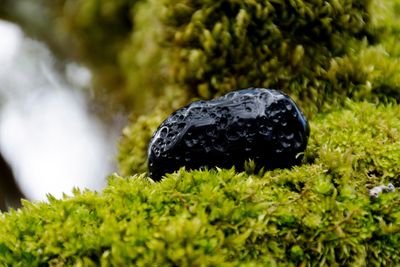


Geologists have found glass pieces known as tektites strewn across a 900-kilometer (560-mile) strip of Brazil. The discovery indicates that around 6 million years ago, South America was struck by a large space rock. This was probably one of the biggest impacts since the dinosaur-killer struck Chicxulub and ended the Cretaceous, but it doesn’t appear to line up with any extinction event.
In the early days after the Earth’s formation, it was something of a punching bag for rocks from space, but as time went by the inner Solar System cleared and major impacts became rarer. Most of the more recent collisions we are aware of were discovered through surviving craters, sometimes so eroded they can barely be made out.
However, impacts can leave other legacies, of which tektites are among the most reliable guides. These small pieces of glass resemble obsidian, made famous by Game of Thrones, but are typically spherical, teardrop or dumbbell shaped, making them useless for blades. They also have distinctive chemistry and can only be created by the massive forces of two large objects slamming into each other.
Tektites vary by location, depending on the composition of the impactor. The Brazilian tektites appear black when found, but under intense light look grayish-green and let some light through. Rather than being truly smooth, the surfaces have small dents like tiny versions of golf ball divots.
“These small cavities are traces of gas bubbles that escaped during the rapid cooling of the molten material as it traveled through the atmosphere, a process also observed in volcanic lava but especially characteristic of tektites,” Professor Alvaro Penteado Crósta said in a statement.
Crósta and colleagues found 500 of these tektites, which they called geraisites, in time for submission in a scientific journal. All those were found within or near Minas Gerais, but while the work was under peer review the team expanded their search and found 100 more, spread over a distance 10 times as long as the original discovery zone.
“This growth in the area of occurrence is entirely consistent with what is observed in other tektite fields around the world. The size of the field depends directly on the energy of the impact, among other factors,” Crósta said. The longest geraisite is 5 centimeters (2 inches) long and weighs 85 grams (3 ounces), but most are much smaller.
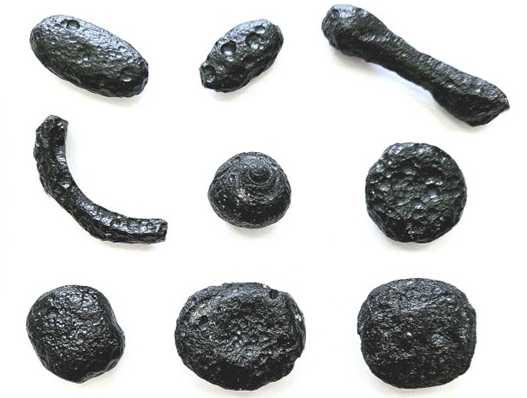
The researchers were tipped off the possibility of a tektite field when residents of a village showed them three samples. They found others by themselves and put out a call more widely, leading to the rich haul.
Only five tektite fields worldwide are generally accepted, with at least two more subject to debate. Claims of asteroid impact legacies have frequently proven controversial, with papers reporting signs of impacts 13,000 and 3,600 years ago being debunked and in some cases retracted. A 6.3-million-year-old impact is unlikely to become tangled in culture wars the way the subjects of those papers have, but the authors are confident their work will prove more robust anyway.
“One of the decisive criteria for classifying the material as a tektite was its very low water content, as measured by infrared spectroscopy: between 71 and 107 ppm. For comparison, volcanic glasses, such as obsidian, usually contain from 700 ppm to 2 percent water, whereas tektites are notoriously much drier,” Crósta said.
Although slightly different ages were obtained for geraisite subsamples using argon isotope ratios, the authors think they are close enough to suggest a single event, with some contamination exaggerating some of the age estimates slightly.
All the known South American impact craters are far too old to be associated with these tektites’ formation, but with so much of Brazil being heavily forested, one might be hard to spot. The chemistry of the samples is consistent with the asteroid having hit the São Francisco craton, one of the geologically oldest parts of South America, which the team hope to explore using surveys of local gravity.
The study is published in Geology.