Space and Physics
 PUBLISHED


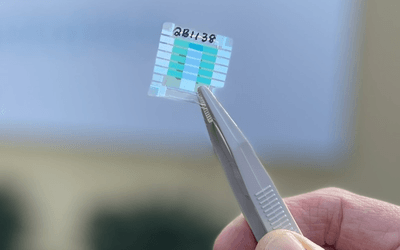


The first quantum battery prototypes are tiny, but they confirm what theoretical physicists had predicted: a capacity to store energy almost unbelievably quickly. The team who developed these prototypes acknowledge there are many hurdles to overcome before quantum batteries can achieve practical sizes, but are optimistic about the prospects of phone batteries that can charge in seconds.
The larger a battery is, the longer it takes to charge. To avoid drivers of electric vehicles having to wait all night for their battery to charge, a race to install faster charging devices is underway. Nevertheless, these still take longer to fill the battery on a truck or bus than a car, and no one is surprised. After all, it takes longer to fill a swimming pool than a bath.
Yet such common-sense rules take a holiday when quantum effects take over. For example, one team proved that quantum batteries could get their energy from a superposition of charging devices, allowing charging to occur much more rapidly than conventional rules allow.
Others have gone further, predicting that quantum batteries could charge collectively. Storage units in the battery would behave as if peer pressure was driving them on, the theory ran, storing more rapidly the more units the battery had. In that case, the larger the quantum battery, the faster it would absorb energy, allowing practical-scale batteries to charge at almost frightening speed.
Dr James Quach of Australia’s CSIRO was first author when an international team demonstrated in 2022 that this effect is real. They created a quantum battery that could be charged by shining lasers on it, absorbing some of the photons’ energy. As theory predicted, the rate of charge is proportional to the inverse of the square root of the battery’s size. In other words, not only would a battery four times as large not take four times as long to charge as its smaller counterpart, it would be quicker, filling in half the time.
That first effort was very much a proof of concept. Not only was it built on a tiny scale, and very inefficient at absorbing the laser’s energy, but it lost its charge almost immediately, failing what many would consider the defining feature of a battery. It also couldn’t do anything useful, since the energy was shed as radiation, rather than electricity.
Now, Quach has led the Australian arm of the previous collaboration in making something considerably more battery-like, while maintaining the key quantum advantages. Crucially, their device releases the energy in electrical form, suited to a world built around electrically powered devices. Moreover, it’s able to hold onto the charge for useful amounts of time, only releasing it when necessary.
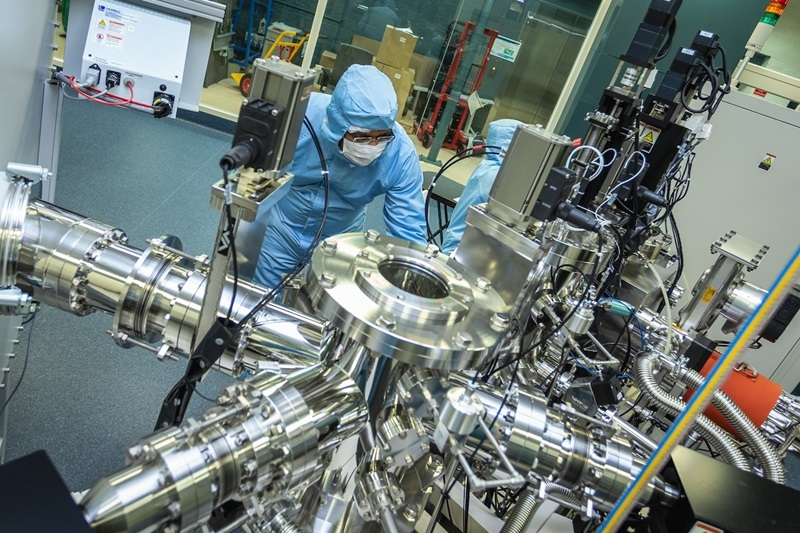
Quach and colleagues are still working on a tiny scale, but when it comes to charging speed, that means everything gets better from here. However, he acknowledged to IFLScience, there are still plenty of challenges.
“Using a laser you can deliver a lot of energy,” Quach told IFLScience. “The bottleneck is the heating. Our solution is to pulse it. We pump the laser for fentoseconds (10-15s) and then give it a break from nanoseconds (10-9s) to cool.” Repeating this on a larger scale, Quach told IFLScience his team calculates they could charge a typical phone battery in 20 seconds. As he notes in a Conversation Article, this would be very handy when realizing you forgot to charge just before you need to leave the house. Even if the team finds the process doesn’t scale perfectly, that still leaves plenty of room for longer pauses without becoming annoying.
A bigger problem could be that the process is currently just 3 percent efficient, with most of the energy in the laser never making it to the battery. That doesn’t matter much for the small-scale batteries the team are working with at the moment, but would make charging an electric vehicle, for example, prohibitively expensive, no matter the benefits of speed.
Fortunately, Quach doesn’t think this inefficiency is inevitable. “The potential is to get close to 100 percent efficiency if we can control photons properly,” he told IFLScience. Whether controlling photons turns out to be like herding cats remains to be seen. For the moment, however, those concerns have taken a back seat with the focus on speed.
Most quantum operations need to take place at temperatures near absolute zero, one of the many hindrances that have seen quantum computers take decades longer than predicted to reach their current state.
Remarkably, Quach told IFLScience there’ll be no need to dip your quantum battery phone in liquid nitrogen. “We don’t need individual control of each quantum cell,” he told IFLScience. “In entanglement, any noise can cause the system to fail, and that includes temperature, but we are using collective effects and don’t need to eliminate noise.”
Besides dramatically widening the potential applications, the fact that quantum battery charging can take place at room temperature turns out to be essential in another way. “At room temperature, we break time symmetry,” Quach said, “So the battery won’t automatically discharge as fast as it charges.”
The team’s new paper describes a sort of hybrid, where a quantum battery is charged via laser, but extra layers cause charge separation to create something more like a conventional battery, which can then be drained electrically at the desired rate.
The study is open access in Nature.