Space and Physics
 PUBLISHED


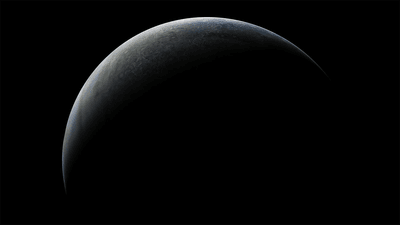


Our Moon likes to mix it up a bit. As well as a nice Full Moon, we get to see it in a lovely crescent shape and a pleasing semicircle as we move through its 29.5-day cycle.
But if you look up at the planets through a sufficiently powerful telescope, you will notice that none of the other celestial bodies have this same dramatic range. If you look at Jupiter, for example, you will notice that you can never view it as a crescent. The same is true of Saturn, Uranus, Neptune, and any dwarf planets beyond the orbit of Mars.
Meanwhile, if you look towards the inner Solar System's planets, you will notice that you can never see a full Venus, nor a full Mercury. Why is that? The easiest way to explain is to look at the Moon.
Around 50 percent of the Moon and Earth are illuminated by the Sun at any given moment. The Moon orbits around the Earth over the course of 29.5 days. As it does so, the amount of lit-up surface varies from the point of view of someone remaining on the Earth.
When the Moon is at the point of its orbit where it is in the direction of the Sun, when viewed from Earth, only the half facing away from us is illuminated. This is the "new Moon" phase, and from Earth you cannot see any lit-up portion of the Moon. As the Moon orbits the Earth through the month, you see more and more of the lit-up side, until it is on the opposite side of the Earth to the Sun, at which point the whole face is lit up (a Full Moon).
From the Earth, you can never see a crescent Jupiter. This is because Jupiter is in a superior orbit, meaning that its orbit is further out than Earth's. As the gas giant is never between the Earth and the Sun, we never see the dark side of it from here on Earth. You may get a slightly different view of Jupiter, but we do mean slight. From our angle, our largest planet is never less than 99 percent illuminated by the Sun.
Then there are the inferior planets, Mercury and Venus, which orbit closer to the Sun than the Earth. In 1610, while observing the phases of Venus, Galileo Galilei figured out that it must orbit around the Sun and not the Earth. The phases observed – or lack of a full Venus – would be impossible were Venus orbiting the Earth, making it clear that a heliocentric model should replace the old Earth-centric Ptolemaic model.
As Venus is closer to the Sun than Earth, the only time when we could see it wholly illuminated is when it is on the opposite side of the Sun to us. Unfortunately, at that point, it is entirely covered by the Sun.
But unlike Jupiter, Venus does have phases, going from not illuminated at all (when it is between the Earth and the Sun) to crescent, when it is slightly to the side of the Sun from our perspective, to a nearly full Venus just before it disappears from view behind our host star.
For a crescent view of Jupiter or a full Venus, you must go beyond them. Thankfully, NASA has done this from time to time, giving us views of the planets we are unable to get from Earth.