


 Health and Medicine
 PUBLISHED
 2
2


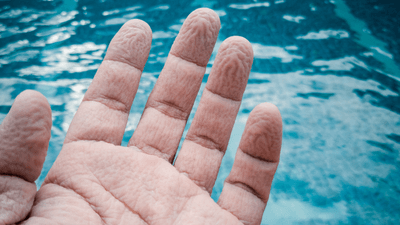


We modern humans love a long hot soak but linger too long and something a bit gross happens: the skin on your hands wrinkles up making them look like fleshy prunes. It’s often assumed that we’re just absorbing water, but skin is waterproof and – actually – not everybody gets pruny in the bath. So, what’s going on?
Pour water on your hand and what does it do? It runs off, and a good thing too as otherwise taking a bath could have fatal consequences. Scientists looking at thin skin shavings discovered it exhibits an unusual arrangement of lipids in which their two hydrophobic tails are pointing in opposite directions.
Typically, the hydrophilic head of a lipid points one way while its two hydrophobic tails point in the other, but by having the tails alternate like this, the lipids are more tightly packed, making the skin even more impermeable. It works both ways, too, so water doesn’t get in or out from under our skin. That means that your wrinkly fingers can’t just be waterlogged, and we’ve already observed how nerve function plays a critical role in the pruny fingers phenomenon.
According to the BBC, it was way back in 1935 that doctors first noticed how patients whose median nerve had been severed didn’t get wrinkly fingers when wet. Depending on where the nerve damage has occurred, you may only get a few fingers that don’t wrinkle (as seen here), or it may happen to the whole hand. In fact, doctors have even suggested using finger wrinkling as a test for nerve damage.
That median nerve is involved in functions that we don’t voluntarily control like sweating, and it forms part of the sympathetic nervous system (something we have to thank for pointy nipples). The sympathetic nervous system is all about getting our body’s systems on alert, by doing things like raising heart rate, respiratory rate, and blood pressure. The parasympathetic nervous system, on the other hand, does the opposite, orchestrating the physiological changes that allow us to calm back down again. It begs the question, if wrinkly fingers fall under the sympathetic nervous system, what are they preparing us for?
One theory is that pruny fingers have roots deep in our evolutionary history as an adaptation that made it easier for us to pick up objects when our hands were wet. The wrinkled palmar and plantar surfaces effectively act as “tire treads” that give us better grip in wet environments. So, say you’re an early human ancestor out foraging for shells, you’ll have a much better success rate than someone with smooth, land-lubber hands.
If you think that sounds bogus, it tracks as an adaptation. The wrinkles act like draining channels so that when you pick up something wet, the grooves push the water out of the way, and you get more skin contact on the object itself. Do the same with a wet object and dry hands and you’re much more likely to get that embarrassing slipping-cartoon-soap-bar effect.
So, something to tell your friends. Just maybe wait until you’re out of the bath to share it with them.


