Space and Physics
 PUBLISHED
 8
8


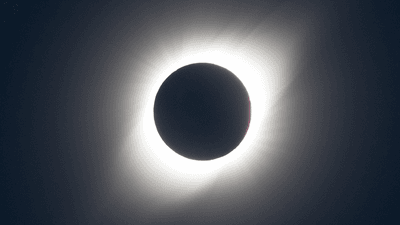


It probably hasn't escaped your attention that this year, on April 8, a total eclipse will pass through North America. The eclipse should be a spectacular one, coinciding with the solar maximum.
"In 2017, the Sun was nearing solar minimum. Viewers of the total eclipse could see the breathtaking corona – but since the Sun was quiet, streamers flowing into the solar atmosphere were restricted to just the equatorial regions of the star," NASA explains.
"During the 2024 eclipse, the Sun will be in or near solar maximum, when the magnetic field is more like a tangled hairball. Streamers will likely be visible throughout the corona. In addition to that, viewers will have a better chance to see prominences – which appear as bright, pink curls or loops coming off the Sun."
The eclipse should be visible from Mexico to Canada. The path of totality – the area where people will see a total solar eclipse – is wider than in 2017, as the Moon is closer to Earth due to where it is in its orbit, meaning more people will see the Sun's corona. NASA even noted that, with luck, they may even see a coronal mass ejection during the eclipse.
The eclipse, of course, is not dangerous to people on Earth. In fact, all the Moon is doing is briefly protecting us from harmful UV rays, like a giant, rocky parasol. So why have there been so many warnings this year about the eclipse? As well as asking people to stock up on fuel, food, and water, various emergency officials have warned that schools should close and residents should stock up on supplies for pets as well.
Simply put, it is due to the expected increase in tourists associated with the eclipse, piling pressure onto local transport and emergency services, which are not designed to cope with such an influx. Advice is to stock up beforehand to reduce the number of cars on the road around eclipse day.
“What we could have is crowds here that we’re not used to,” Dave Freeman, Lorain County EMA director, explained in a statement seen by USA Today, while urging local residents to stock up on supplies. “We’re not set up infrastructure-wise for that, we don’t have the roads.”
“A lot of the roads here are two lanes,” Freeman added, per Yahoo News. “This is not Chicago, this is not Cleveland, where we have a bunch of four-lane, six-lane roads coming in so the traffic could be pretty extreme here if we get crowds more than we expect."
Cell phone towers could become overloaded too. Schools in some counties in Texas have been warned to shut to relieve some of the traffic stress by removing the school run from the equation.
As always, there will be people who will say "We didn't have these kinds of warnings in 2017/some previous eclipse and everything was fine!" to which the answer is: no it wasn't. Ahead of the 2017 eclipse, local government planned for an increase in visitors, but traffic congestion was still a problem.
"The millions of people drawn to locations along the eclipse path taxed limited transportation facilities, and traffic congestion was intense in many locations," transportation engineering consultant Jonathan Upchurch explained in Transportation Research News.
"Across the country, Interstate highways near the path of totality experienced traffic congestion shortly after the eclipse, with longer-than-normal travel times on Interstate highways. For example, travel from Casper, Wyoming, to Denver, Colorado— normally a 4-hour trip—took 10 hours or more. Traffic congestion on rural Interstate routes lasted for up to 13 hours after the eclipse."
Additionally, though you may have missed them, there were warnings in place ahead of the 2017 eclipse. What's more, they were effective, so it makes sense that officials are using them ahead of this year's eclipse.
"The data showed that Oregon, Idaho, and Wyoming had the most significant traffic increase on the eclipse day compared to other states," a paper on traffic management during the 2017 eclipse explains.
"Interestingly, Nebraska, Kansas, and Missouri had reduced daily traffic, one of the reasons might be the advice from transportation agencies for people to reduce their errands during the eclipse week."