Space and Physics
 PUBLISHED



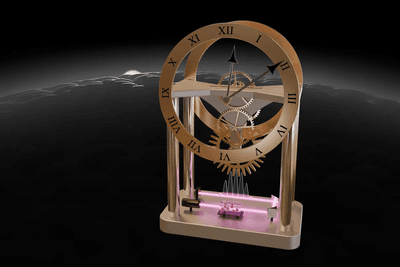


Back in 2024, a joint collaboration of researchers from TU Wien in Austria and the National Institute of Standards and Technology in the US announced the development of the first optical nuclear clock. Almost two years on, they have continued to improve this device, and they can now use it to look for peculiar physics effects.
"With this first prototype, we have proven: Thorium can be used as a timekeeper for ultra-high-precision measurements. All that is left to do is technical development work, with no more major obstacles to be expected," co-author Thorsten Schumm, from Vienna University of Technology, said in a statement two years ago.
What makes this clock special?
Extreme timekeeping is done using lasers and atoms. By tuning the laser to the "resonant frequency" of an atom's electrons, the precise frequency at which they absorb the laser's energy, it will cause them to jump between energy levels. These jumps can be detected, and the calibrated laser can then be used to measure the passage of time.
In standard atomic clocks, the laser used is in the microwave range, and the atoms are cesium. In more modern optical atomic clocks, scientists use shorter wavelengths and different atoms, leading to much higher precision. But electrons are still the basis of the measurement.
This is what makes the Thorium-229 clock so exciting. It doesn't use the electron transition and instead calibrates the laser against the resonant frequency of the nucleus at the heart of the atom. The energy transition at the nuclear level is a lot more stable than the electron transition, providing an edge that makes these types of devices many times more precise.
But if nuclear clocks are so good, why aren't we using them all the time? The problem is that nuclear transitions usually require much higher energy than electron transitions and so can be delivered only with an X-ray laser. Thorium-229 is an exception: it has the lowest nuclear energy jump of any known atom, requiring ultraviolet light, making it much easier to use.
What has this thorium clock been used for?
Regular optical atomic clocks still have an edge compared with this new thorium clock. This is because there are still uncertainties in the exact value of the resonant frequency of the thorium nucleus. Still, the new system is catching up.
The thorium clock loses a few tens of seconds every billion years. It also doesn’t need to be in a vacuum or near absolute zero, which the current setup used to define the standard value of a second requires. The thorium is embedded in a calcium fluoride crystal, and it is used at room temperature.
A nuclear clock is also less affected by the electromagnetic interactions that influence the electrons spinning around an atom. For this reason, even though it is less precise, this prototype can be used to test physical properties that might affect other kinds of clock, including gravity.
As reported in a paper awaiting peer review, the team used it to constrain models of ultralight dark matter. Dark matter is a hypothetical substance that exists in the universe, but it is invisible since it only interacts gravitationally and not with light (or at least not very much). According to certain hypotheses, dark matter could be made of particles with a tiny mass. In those scenarios, it would cause fluctuations in the nuclear transition energy.
The team, which included researchers from Physikalisch-Technische Bundesanstalt (PTB) – the national metrology institute of Germany – was able to constrain the models at a precision similar to that of optical clocks, though for a slightly different model of ultralight dark matter.
The clock also delivers higher precision measurements for the coupling of the quarks – the components of protons and neutrons in the nucleus – and the strong nuclear force that keeps the nucleus together.
The paper, which has yet to be peer reviewed, is available on ArXiv.
[h/t: New Scientist]
This article was amended to note the contribution of researchers from Physikalisch-Technische Bundesanstalt.