


 Technology
 PUBLISHED


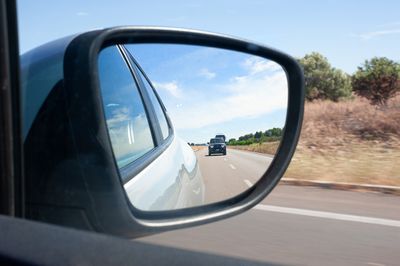


It’s one of the lessons that any driving instructor worth their salt will tell you early on – be mindful of the fact that objects in your side-view mirror are actually closer than they appear to be. And, if their student just so happens to be curious, the next question out of their mouths might just be: “But why?”
The answer lies in how a car’s side-view mirrors are designed. They are convex, meaning they are curved or rounded outward. The advantage of such a shape is that it gives a driver a wider field of view, allowing drivers to see more potential hazards. Essentially, it’s a safety enhancement.
It’s the same reason why you might see also convex mirrors strategically placed at the end of someone’s driveway or at tricky junctions to help people see around corners – though these ones tend to look a lot more obviously fish-eye shaped than the ones on a car.
The downside to a convex shape is that it essentially distorts the size of the objects that appear within it. In turn, this alters the driver’s perception of the distance between an object and the car they’re driving, which presents a safety issue if you’re not aware of this effect.
If a car behind you looks far enough away, you might be tempted to do something like quickly switching lanes when there’s actually not a safe enough distance between you to do so. In many places, the warning “objects in the mirror are closer than they appear” is often etched into a car’s side-view mirrors as a permanent reminder to be cautious in pulling off such maneuvers.
Is there a type of mirror that could represent some sort of middle ground? People have certainly tried – namely Dr R. Andrew Hicks, a professor of mathematics at Pennsylvania’s Drexel University.
Back in 2012, Hicks obtained a patent in the US for a design that he created using an algorithm that involved tens of thousands of calculations, resulting in a mirror that had a 45-degree field of view but minimal distortion.
“Imagine that the mirror’s surface is made of many smaller mirrors turned to different angles, like a disco ball,” Hicks said in a statement made at the time.
“The algorithm is a set of calculations to manipulate the direction of each face of the metaphorical disco ball so that each ray of light bouncing off the mirror shows the driver a wide, but not-too-distorted, picture of the scene behind him.”
Sadly, the mirror doesn’t actually look like a disco ball when you get a closer look at it, but in hindsight, that’s probably a good thing – disco ball side mirrors would be pretty distracting.




 1
1