Space and Physics
 PUBLISHED





While exploring its natural habitat – the Bermuda Triangle – in 2022, History Channel stumbled across an intriguing piece of material, prompting them to contact NASA for further analysis.
Intrigue surrounding the Bermuda Triangle, a loosely-defined area of ocean between Florida, Puerto Rico, and Bermuda, can largely be traced back to an incident in 1945, known as "Flight 19".
On 5 December 1945, five TBM Avenger torpedo bombers carrying 14 men were participating in a mock bombing run in the Bahamas, a training exercise for student pilots.
In the second leg of the exercise, the team ran into some unusual trouble. In intercepted radio messages, one student pilot could be heard asking a crew member for a compass reading.
"I don’t know where we are," they could be heard replying. "We must have gotten lost after that last turn."
U.S. Navy Lieutenant Charles Carroll Taylor, an experienced pilot leading the flight, was later heard confirming similar issues to another pilot.
"Both my compasses are out, and I am trying to find Fort Lauderdale, Florida," he said in the recordings. "I am over land, but it’s broken. I am sure I’m in the Keys, but I don’t know how far down and I don’t know how to get to Fort Lauderdale."
That pilot urged Taylor to use the Sun, putting it on the port side, and the coastline to navigate their way back to Fort Lauderdale, but for reasons unknown, the advice was ignored.
"If we would just fly west we would get home," one voice was heard saying. "Dammit, if we would just fly west we would get home."
In one communication, Taylor can be heard saying that when the first plane's fuel goes below 10 gallons, then all planes would attempt a water landing. But the planes didn't return, and they likely went down in the ocean, never to be seen again. Since then, other incidents of lost planes and ships have been attributed to the "Bermuda Triangle", and it has became a popular mystery.
These days, there is waning interest in the Bermuda Triangle, with studies finding there is no real mystery to solve here, as the area does not see a statistically significant number of disappearances compared with other areas of the ocean. But that won't deter an organization as dedicated as History Channel – which these days is known for some of its more sensationalist programming – from investigating, and in this case we're glad they did.
In 2022, the channel was filming the program The Bermuda Triangle: Into Cursed Waters in Florida, searching for World War II aircraft on the ocean floor, when they spotted a large piece of wreckage partially obscured by sand off the coast. Looking at the object, they found it was clearly of human construction, and covered in 20 centimeter (8 inch) square tiles. As well as that, divers could tell that it did not come from an aircraft.
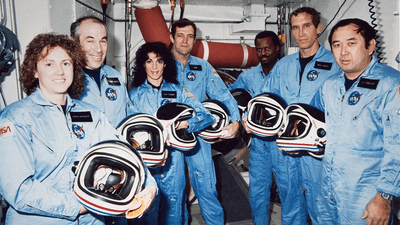
Knowing they were close to Florida, which NASA essentially uses as a big launch pad, History Channel contacted the US space agency for its opinion. Soon, the agency confirmed that the debris was an artifact from the space shuttle Challenger, which tragically broke apart 73 seconds into its flight in 1986, killing all seven astronauts on board. The disaster, investigations determined, was the result of two failed O-rings sealing a joint on one of the rocket boosters.
“While it has been nearly 37 years since seven daring and brave explorers lost their lives aboard Challenger, this tragedy will forever be seared in the collective memory of our country. For millions around the globe, myself included, Jan. 28, 1986, still feels like yesterday,” then NASA Administrator Bill Nelson said in a statement.
“This discovery gives us an opportunity to pause once again, to uplift the legacies of the seven pioneers we lost, and to reflect on how this tragedy changed us. At NASA, the core value of safety is – and must forever remain – our top priority, especially as our missions explore more of the cosmos than ever before.”
A salvage operation shortly after the disaster, the largest ever attempted, recovered 167 pieces of the shuttle, weighing a total of 118 tons, but other pieces such as the one discovered above are likely still laying on the ocean floor.