Health and Medicine
 PUBLISHED


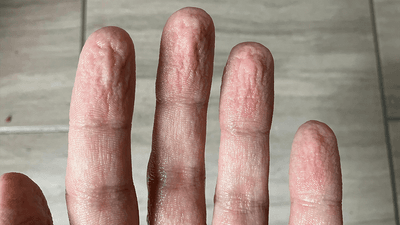


A new study inspired by a student's question has found something surprising about human fingers, and how they wrinkle after being placed in water.
When you put your fingers into water for a reasonable amount of time, you probably notice that they begin to go wrinkly, or "prune-like" in appearance. While you may reasonably guess that this is because of your fingers becoming waterlogged, this is not the case. In 1935, doctors noticed that patients with damage to the median nerve running down the arm to the hand do not get wrinkles on their fingers after their hands are submerged in water, suggesting that the phenomenon is controlled by our nervous systems. If it were a case of skin being waterlogged, water-induced prune fingers would not be absent in patients with nerve damage.
"Functions like breathing, blinking, your heart pumping or your pupils constricting in the sun all happen without your needing to consciously control them, thanks to the autonomic nervous system. It also automatically controls the expansion and contraction of your blood vessels. Typically, temperature, medications or what you eat or drink can cause your blood vessels to expand or contract. Think of how your skin may flush of its own accord when you go out into a hot day, exercise or even blush," Guy German, Associate Professor of Biomedical Engineering, Binghamton University, State University of New York, and lead author on the new paper explained in a piece for The Conversation.
"This contraction of your blood vessels is also what causes the skin to wrinkle after a lengthy swim. When your hands and feet come into contact with water for more than a few minutes, the sweat ducts in your skin open, allowing water to flow into the skin tissue. This added water decreases the proportion of salt inside the skin. Nerve fibers send a message about lower salt levels to your brain, and the autonomic nervous system responds by constricting the blood vessels."
After writing that piece aimed at children in 2023, German received a number of questions, one of which had him stumped.
"A student asked, 'Yeah, but do the wrinkles always form in the same way?' And I thought: I haven't the foggiest clue!" German, a faculty member at the Thomas J. Watson College of Engineering and Applied Science's Department of Biomedical Engineering, said in a statement. "So it led to this research to find out."
In the study, the team got participants to submerge their hands in water for 30 minutes before photographing them, and then repeating the process at least 24 hours later. When they looked at the patterns, they found
"This work conclusively reveals for the first time that topographical wrinkle patterns caused by prolonged human hand immersion in water are repeatable and consistent at different timepoints," the team writes in their study. "Qualitatively, images from each of the five fingers on subjects are compared at different time points. These reveal similar wrinkles over a 24 h period."

Though interesting in its own right, the work could have implications in forensics, for example in fingerprinting, or identifying bodies found after prolonged water exposure. As for why the patterns are so similar, that may have a pretty simple explanation.
"Blood vessels don't change their position much—they move around a bit, but in relation to other blood vessels, they're pretty static," German explained. "That means the wrinkles should form in the same manner, and we proved that they do."
He added that he is keen to investigate more questions about skin immersion with his own students.
"I feel like a kid in a candy store, because there's so much science here that I don't know," he added. "We thank the people at The Conversation and the wonderful question they asked us, because it does create cool new science."
The study is published in the Journal of the Mechanical Behavior of Biomedical Materials.