Space and Physics
 PUBLISHED



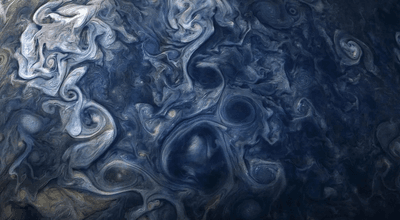


Jupiter is the largest planet in the Solar System, a gas giant that could fit over 1,000 Earths inside. It is a phenomenally complex world, and there is so much we do not know about this planet. That includes what goes on deep underneath its clouds.
The Juno mission has been sent to Jupiter by NASA to provide our best understanding of what goes on inside the planet, but questions remain – questions that can be answered with models. Researchers have published the first model that combines both chemistry and the behaviors of water droplets and clouds in the atmosphere of Jupiter. They are calling it the most complete model of the Jovian atmosphere to date.
The new calculations provide a lot of intriguing findings, and one of particular interest is the abundance of oxygen on Jupiter. This is not about habitability, but it might be a crucial clue about where Jupiter formed. Stars tend to dry out their closer regions, getting rid of water ice and, thus, oxygen. Farther out from the Sun, there’s a lot more ice that can be used as a building block of planets.
The abundance of oxygen inside Jupiter is a major, unsolved problem. For decades, researchers have argued about this value, including a recent study placing it as low as one-third of the Sun’s abundance. The model instead suggests that Jupiter likely has about one and a half times more oxygen than the Sun.
"This is a long-standing debate in planetary studies," first author Jeehyun Yang, a postdoctoral researcher at the University of Chicago, said in a statement. "It's a testament to how the latest generation of computational models can transform our understanding of other planets."
The team was also able to look at motion through the atmosphere. We have observed its enormous storm, the Great Red Spot, for centuries, and missions like Galileo and Juno have given us even more insights into the many storms peppering the planet.
It has been known that the atmosphere also circulates up and down, but another fascinating finding of the model is that this is going a lot more slowly. A single molecule might take multiple weeks to go through one layer, not hours as previously thought.
"Our model suggests the diffusion would have to be 35 to 40 times slower compared to what the standard assumption has been," explained Yang. "It really shows how much we still have to learn about planets, even in our own Solar System."
The study is published in The Planetary Science Journal.