Health and Medicine
 PUBLISHED
 8
8


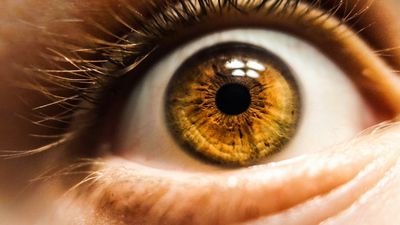


Once upon a time, all humans on Earth had brown eyes until a single person had a genetic mutation affecting the OCA2 gene, perhaps as recently as 6,000 to 10,000 years ago. The chance mutation impacted the production of melanin pigment in the iris, giving rise to lighter shades of eyes, from amber and hazel to green and blue.
It was previously believed that just a couple of genes simply controlled eye color, but scientists have since figured out it's linked to dozens and dozens of genes. Despite this complexity, there are clear trends in how eye color manifests across different parts of the world.
The most common eye color
Brown eyes are the most common eye color of modern-day humans. However, the proportion of different eye colors varies massively from region to region, country to country.
In the US, 45 percent of the population have brown eyes, 27 percent have blue eyes, 18 percent have hazel eyes, 9 percent have green eyes, and the remaining 1 percent have an eye color not listed above. That’s according to a 2014 survey of 2,000 people in the US by the American Academy of Ophthalmology.
Elsewhere in the world, things are very different. Although few studies have looked into eye color in Africa, it’s apparent that brown is the predominant color, likewise in South Asia and East Asia.
A 2019 study looked at data on eye color for some countries across Europe and Central Asia, breaking it down into "brown/hazel", "intermediate", and "blue". While countries like Armenia had over 80 percent brown eyes and 3 percent blue, Iceland had 9 percent brown eyes and 74 percent blue.
Here’s how the rest of the results broke down:
| Country | Blue Eyes | "Intermediate Eyes" | Brown Eyes |
| Armenia | 3.05 % | 16.78 % | 80.15 % |
| Denmark | 64.84 % | 20.45 % | 14.50 % |
| Great Britain | 42.80 % | 25.46 % | 31.77 % |
| France | 22 % | 44 % | 34 % |
| Georgia | 7.51 % | 18.79 % | 73.68 % |
| Germany | 39.6 % | 33.2 % | 27.2 % |
| Kazakhstan | 3.33 % | 11.65 % | 85 % |
| Ukraine (Crimea) | 25 % | 24.99 % | 50 % |
| Uzbekistan | 3.44 % | 6.02 % | 90.51 % |
What's up with blue eyes?
You might be wondering why Europe has more variation in eye color than the rest of the world, specifically in regard to blue eyes. Scientists aren’t totally sure about the answer, but they've put forward a few theories.
One idea is the "vitamin D hypothesis", which suggests light-colored skin, hair, and eyes helped prehistoric humans adapt to the northern latitudes where light is less plentiful. Another idea is that it had something to do with Europeans having more Neanderthal genes. In reality, it’s likely to be a complex meddle of factors involving genetic drift, founder effects, relaxation of natural selection, and sexual selection.
And no, there’s no evidence that blue eyes are falling to extinction. The genes that code for blue eyes are recessive, while brown eyes are dominant, meaning a person needs to inherit the genes for blue eyes from both parents to possess the characteristic.
This has led to some erroneous claims that blue eyes might eventually become diluted out of the population (similar claims are often said about ginger hair too). However, blue eyes are very unlikely to die out in the foreseeable future simply because enough people carry the genes to keep the recessive traits in the human population.
Just like redheads and attached earlobes, blue eyes are a recessive trait that are likely here to stay.