Space and Physics
 PUBLISHED
 6
6



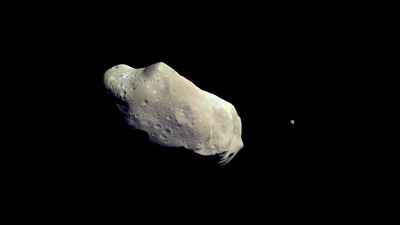


The Asteroid Belt seems such a neat division in the Solar System, separating the four rocky planets and four giant planets. Asteroids don’t just stay there, though; plenty of space rocks get dangerously close to Earth. You might think those asteroids ought to be in the Asteroid Belt, and you would be right. They used to be there, until they entered one of the Kirkwood Gaps.
The Asteroid Belt doesn’t look like asteroid fields in movies, filled with rocks constantly hitting each other. Space is big, and the region between Mars and Jupiter is vast; even though millions of asteroids are there, they are not bunched up together. In fact, interestingly, some orbits seem to be devoid of asteroids. Those are the Kirkwood Gaps.
American astronomer Daniel Kirkwood noticed in 1866 that asteroids’ semi-major axes were missing several numbers. Asteroids, like other bodies orbiting the Sun, move on an elliptical orbit: the semi-major axis is half of the longer diameter of the orbit. If we take the Earth-Sun distance to be 1 astronomical unit (AU), the population of asteroids drops at 2.5 AU, at 2.825 AU, 2.96 AU, and 3.28 AU. There are other gaps, but these are the most important.
The semi-major axis is related to the period of these asteroids, and Kirkwood correctly worked out what was responsible for the lack of asteroids in those specific orbits: Jupiter. Basically, an asteroid that has a semi-major axis of 2.5 would have a period of 3.95 years. It goes around the Sun three times during the time it takes Jupiter to do one orbit. An asteroid in the 3.28 AU gap would be doing two orbits every one of Jupiter.
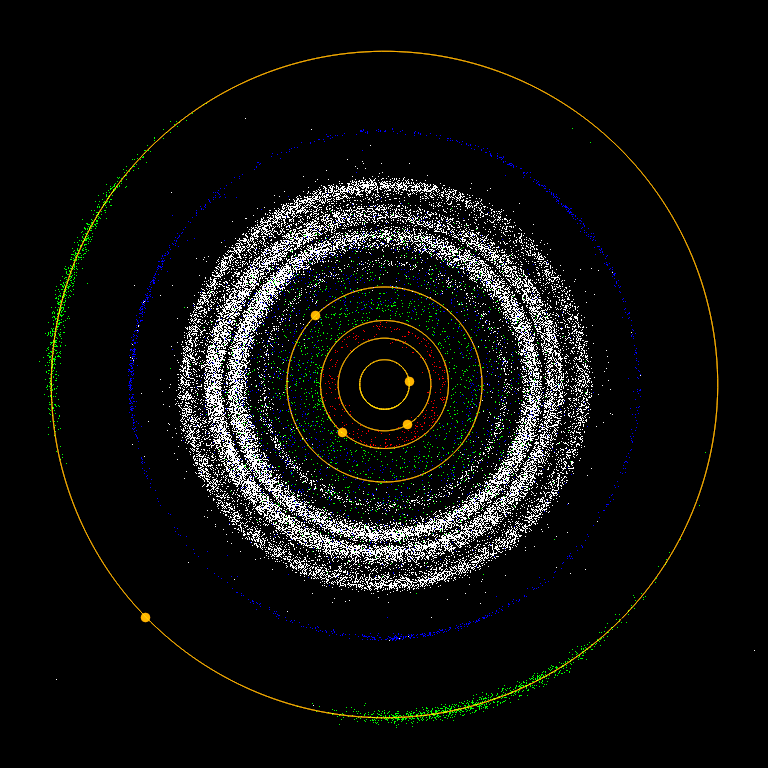
This synchronization is known as being in resonance. There are plenty of examples where resonance produces stable setups, but this is not the case for the Kirkwood Gaps. The orbital elements of asteroids in these gaps vary chaotically. This leads the asteroids to begin crossing the inner planets' orbits, within just a few million years. That’s when the problem (and the danger to Earth) starts.
The inner planets orbit the Sun a lot more quickly than Jupiter, so when these asteroids come into close contact with the planets, their orbit can be shifted and pulled inwards. And that’s how you can get Near-Earth orbits.
Consider the recent discovery that both Asteroid Bennu and Asteroid Ryugu, which have been visited independently, are likely fragments of the same asteroid Polana. The collision that formed them must have put them on a peculiar orbit, likely close to those gaps. Eventually, they were tossed out towards the inner Solar System, with Bennu becoming the most dangerous known asteroid.
Jupiter has often been described as the protector of the inner planets, as its gravitational influence blocks and alters the trajectories of outer Solar System objects, preventing them from getting too close, and that includes some comets. At the same time, the Kirkwood Gaps show that the giant planet’s gravitational influence can also be dangerous for Earth. You win some, and you lose some.