


 Humans
 PUBLISHED



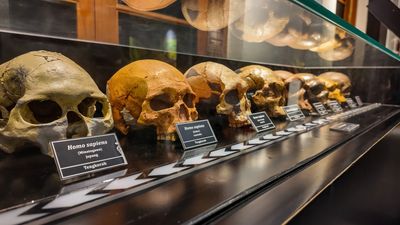


The question of who we are as a species has long plagued philosophers and scientists alike. From how we interact with the world, to how we think about ourselves, to the very words we use to describe each other, it affects just about every aspect of life as a human. So what’s the answer? Or, rather – are there answers?
The common name for our species, “human”, has a pretty simple etymology: it comes from Latin, via French. Six or seven centuries ago, the word was humayne or humain, the same as in French at that time; a millennium before that, when the Romans were roamin’, it was humanus. It has, given how long we’re talking here, not changed much.
But if we go even further back, things get interesting. The origin of humanus is something of a mystery, but it’s most likely connected to homo – Latin for, well, a human. And homo, quite pleasingly, originates in the Proto-Indo-European *ǵʰm̥mṓ, a form of *dʰéǵʰōm which implies participation. And that latter word? That’s the Proto-Indo-European word for earth – meaning an ultimate translation of “human” is pretty legitimately “Earthling”.
Outside of English, the story of “human” can be equally as enchanting. In Chinese, for example, the word 人 is hypothesized to be related to 仁 – which is believable, since they both sound exactly the same: rén. If that’s correct, it means that to be “human” (人) is to be “kind” or “good” (仁). Going even further back, we reach the Proto-Sino-Tibetan *s/k-niŋ, meaning brain, heart, and mind – rendering the ultimate meaning of “human” as “the possessor of a mind”.
Weirdly, there’s a word you might be more familiar with that has basically the same story: animal, which traces back to the Latin anima, or “spirit; mind”. But that raises an interesting question: when did humans start – or stop – thinking of ourselves as animals?
Humans
We will almost certainly never know when humans first started thinking of ourselves as separate from the natural world around us – but a reasonable estimate might be about 40,000 years ago. Why? Because that’s when we see the first evidence emerge for myths, totems, and rituals – the kinds of things people have always done in a vain attempt to control the world around them.
From there, the development of agriculture, religion, and tradition continually reinforced the idea of humans as something separate from other animals. But of course, we’re not that – we’re as animal as they come; just as much a product of evolution’s random mutations as a whale or a shrew or a Gila monster. So, when did we work that out?
The answer may be earlier than you think. It was none other than Plato – commonly considered to be the founder of the Western philosophical tradition – who first described humans as “featherless bipeds”. “I say, then, that we ought at that time to have divided walking animals immediately into biped and quadruped,” he wrote in his late 4th-century BCE dialogue The Statesman, “then seeing that the human race falls into the same division with the feathered creatures and no others, we must again divide the biped class into featherless and feathered.”
Now, you may see a problem with this definition, and you’re not the only one. This description famously landed Plato in hot water when Diogenes, famous Ancient Greek reply guy, burst into one of Plato’s lectures brandishing a plucked chicken and proclaiming “Behold – a man!”
Understandably, the definition changed. Plato reacted by reclassifying humans as “a featherless biped with broad nails”, which rather implies he missed Diogenes’s point; his student Aristotle would later claim that humans are defined by their participation in society, calling us the zoōn politikon – the “political animal” – and claiming that humans are “more political animals than any kind of bee or any herd animal”, which suggests a limited knowledge of bees, at the very least.
These terms gave way to the term animal rationabile or “rational animal” – which might be overstating things, we’re just saying – used by medieval and Renaissance scholars. And then, everything changed. Why? Because of one guy named Carl.
Homo
Carl Nilsson Linnaeus was a kid with a simple dream: to know the exact number and placement of all the teeth and tits in the animal kingdom.
We’re not kidding. Well, kinda: upon spotting a random horse jaw at the side of the road, he lamented that “if only I knew how many teeth and of what kind every animal had, how many teats and where they were placed, I should perhaps be able to worth out a perfectly natural system for the arrangement of all quadrupeds.”
It was a weird thing to say, no doubt, but it led to one of the most important developments in zoological history: the binomial system of nomenclature. Three years later, in 1735, he published his Systema Naturæ, containing about 10,000 species of plant and animal – including humans.
He didn’t get everything right: instead of Primates, he initially included humans as part of the group Anthropomorpha, which he split into Homo (humans), Simia (apes and monkeys), and, um, Bradypus (sloths). Evidently he realized at some point that sloths aren’t very closely related to apes at all, and revised the group: by 1758, the group was named Primates and comprised Homo, Simia, Lemur, and of course, Vespertilio – the bats.
Look, you can’t get everything right, especially when you’re a trailblazer. But ignoring the oddball interlopers, there’s something very significant going on there: it was the first time humans had ever been formally classified as a type of ape, basically on par with, say, a chimpanzee.
As you might imagine, it wasn’t without controversy. “The choice to include humans within animals and quadrupeds was not welcomed by everyone,” explained Isabelle Charmantier, Head of Collections at The Linnean Society of London, in 2020. “In a letter dated 1 September 1735, the Dutch naturalist Gronovius told Linnaeus that he disagreed with his decision to include humans under Quadrupeds ‘For although Man ranks first among the animals, he should in fact be considered to excel all other living beings which were created by God to Man’s delight and benefit’.”
But Linnaeus was rightfully stubborn. “He challenged […] the rest of the world to name a generic difference between man and ape,” Charmantier wrote, “based on the principles of natural history.”
Homo sapiens
Time has, so far, proved Linnaeus right on that one – though notably not some of his more specific classifications of humans. It was he, too, who gave us our defining characteristic: he “distinguished [humans] from other animals in the same order of Anthropomorpha by the ability to ‘know thyself’ (‘Nosce te ipsum’),” Charmantier explained. “This would lead Linnaeus to attribute the specific epithet sapiens to the genus Homo when he began to use his binomial nomenclature in the 1750s.”
Humans were finally back in the animal kingdom, where we belong – and as a “thank you”, science granted Linnaeus a unique honor. See, every species has a type – a single specimen selected to represent the entire species. In broad terms, it can be a holotype, designated in the organism’s initial description and usually kept for a museum or public collection for posterity, or a lectotype, which is the same but designated later, retroactively.
Either way, it ought to be well-described, and the earliest such description on record if possible. For Homo sapiens, there’s really only one person it could be: Carl Linnaeus.



 2
2