Humans
 PUBLISHED
 1
1


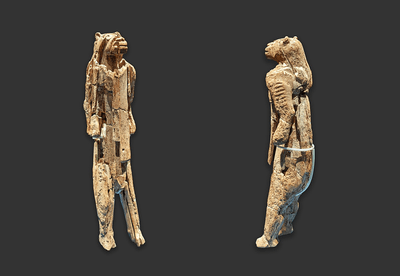


In August 1939, just a few weeks before the outbreak of the Second World War, a scattering of ivory mammoth fragments was discovered in the Hohlenstein-Stadel cave of southern Germany. The pieces were taken to the nearby Museum of Ulm, where they sat quietly for years.
As the war raged, work on the site was abandoned. The city of Ulm suffered heavy bombing, but remarkably, the ivory pieces survived, waiting in the museum’s storage until they could finally receive the attention they deserved.
In 1969, archaeologist Joachim Hahn came across the prehistoric pieces and had a “eureka moment.” Using stone tools available in the Ice Age and 400 hours of fiddling, he assembled roughly 200 pieces of ivory like a Lego model. By 1988, additional fragments discovered in the cave were added to the reconstruction, further refining the figure and bringing it closer to its current (and perhaps original) form.
The result was a 0.3-meter- (1 foot-) long figurine depicting a human body topped with the head of a lion. The animalistic appearance was seemingly inspired by the Eurasian Cave Lion, an extinct species that once prowled around Eurasia and the northwestern corner of the Americas.

The sculpture became known as the Löwenmensch, or the Lion Man of Hohlenstein-Stadel. Later research showed it was unearthed from a layer of sediment in the German cave that dated to somewhere between 36,000 and 40,000 years ago, making it the oldest known statue and one of the oldest examples of figurative art.
The importance of this Ice Age masterpiece cannot be overstated. The Löwenmensch beautifully illustrates that early modern humans possessed imagination, symbolic thought, and the capacity to conceive of things and beings that did not exist in the natural world. The fantastical form of the sculpture even suggests the presence of complex belief systems, possibly involving mythology, shamanistic practices, and – dare we say – religion.
Prior to around 40,000 years ago, there is little surviving evidence of humans expressing such ideas through objects that have survived into the modern age.
It wasn’t until around 38,000 years ago that the world started to see a proliferation of this kind of figurative art across Eurasia and beyond. It’s uncertain what sparked this prehistoric artistic revolution, but it might be a reflection of our societies becoming more complex and a deeper need to build social connections, forged by a shared visual culture.
The precise meaning of the Löwenmensch remains elusive and scholars continue to debate its purpose, identity, and veracity. One bold theory suggests that the Lion Man is, in fact, a woman. This is based on evidence that some Palaeolithic societies may have been matriarchal and created artworks that seemed to celebrate the female form, such as the Venus figurines of Ice Age Europe. Besides anything, the sculpture’s genitals are indistinct, leaving room for interpretation and disagreement.
Another team of archaeologists have argued that it isn’t a human-lion hybrid figure at all, but a skinny bear standing upright. They also doubted the dating of the relic and questioned Hahn’s process of sticking together odd bits of ivory to make the sculpture.
Intriguingly, though, many Palaeolithic cultures across the world created artworks that depict strange semi-beast forms; half-human, half-wild animal (the Sphinx, anyone?)
A very similar lion-like sculpture, also carved out of mammoth ivory, has been found in the Hohle Fels Cave of southwestern Germany, as well as other parts of Europe.
This begs the question: Did these artists arrive at the same symbolic ideas independently, as if channelling some archetype in the human mind, or does it suggest they were part of the same cultural network, sharing ideas about spirituality and a world beyond immediate experience?