Humans
 PUBLISHED
 92
92




It’s a well-established (and slightly uncomfortable) fact that Homo sapiens and Neanderthals interbred with one another. Recent research looked into when this inter-species canoodling occurred and now another new piece of research has investigated where exactly it happened.
Scientists took a close look at the geographical distribution of both species in Southwest Asia and Southeast Europe around the time we know they hooked up during the Late Pleistocene.
This revealed a clear location where the two human species overlapped with each other and likely interbred: the Zagros Mountains, a long mountain range on the Persian Plateau that stretches across the modern-day borders of Iran, northern Iraq, and southeastern Turkey.
The Zagros Mountains would have been an ideal place for the two species to rendezvous. The region has a diverse range of biodiversity and topography capable of supporting large stable human populations. Plus, it could have welcomed humans from other parts of the planet during the Pleistocene climatic shifts, acting as a corridor connecting the cooler Palearctic realm with the warmer Afrotropical realm.
The location also neatly lines up with the archeological record and genetic evidence. The Zagros Mountains region is rich in archaeological sites containing the remains of both Neanderthals and prehistoric Homo sapiens.

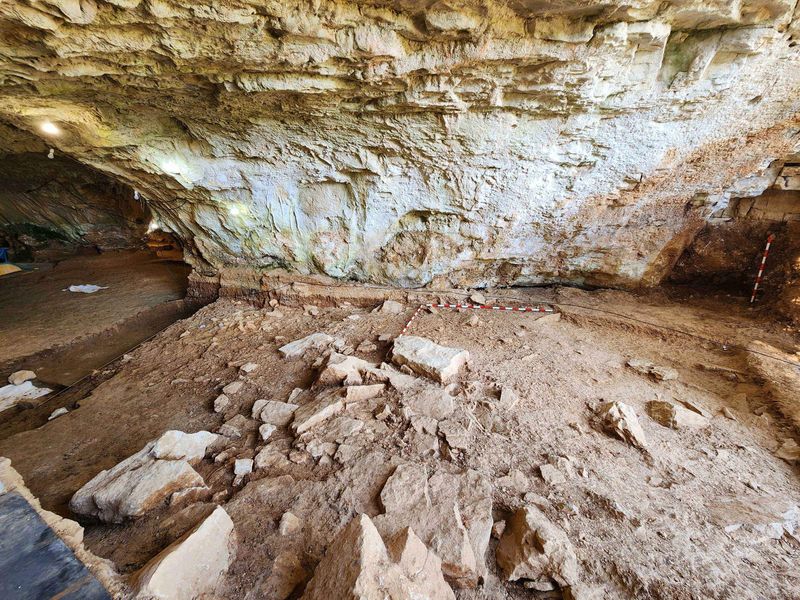
One of the most famous is the Shanidar Cave in the Kurdistan Region of northern Iraq, which holds the best-preserved Neanderthal skeleton ever unearthed. It’s also the location of the famous “flower burial”, a Neanderthal skeleton that appears to have been scattered with plant pollen. Whether or not the placement of flowers was intentional remains controversial.
Around the same time that Neanderthals were in the region, evidence shows that the Persian plateau served as an important hub for Homo sapiens as they embarked on their main migration out of Africa.
Altogether, several strands of evidence suggest that the Zagros Mountains – sat on the crossroad between Europe, Asia, and Africa – was the place where the different human species would run into each other around the time we know interbreeding took place.
The legacy of this interspecies romping still lives on today. Scientists discovered that Homo sapiens and Neanderthals interbred in 2010 when they first sequenced the full Neanderthal genome.
With further work, it was revealed that between 1 and 4 percent of the genomes of all non-African humans alive today derive from Neanderthals. These genes continue to shape many facets of our appearance and behavior, from bigger noses and lower pain thresholds to higher vulnerability to COVID-19 and depression.
The new study is published in the journal Scientific Reports.