Space and Physics
 PUBLISHED



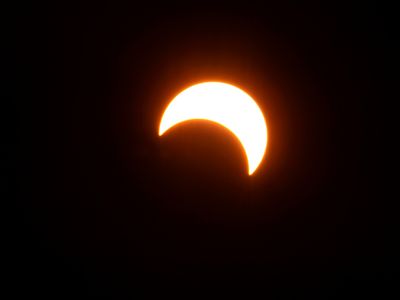


Get those eclipse glasses ready! Later this week, many areas in the Northern Hemisphere will witness a partial solar eclipse. At no point will the Sun's disk be completely covered, so to witness the celestial event you need to make sure you use the right protection.
The event will happen on March 29 in the morning local time for most of the areas from where it is visible. The full event from beginning to end will last a couple of hours.
“On the morning of the 29th March, large parts of Europe, Greenland, Iceland, and north-eastern Canada will witness a partial solar eclipse, where the Moon will pass in front of the Sun, blocking out some (but not all) of its light,” Jake Foster, an astronomer at the Royal Observatory Greenwich, told IFLScience.
“Canada will see the best of the eclipse, with 92 percent of the Sun being obscured by the Moon as seen from places like Quebec and Newfoundland and Labrador. From the UK, between 30 and 45 percent of the Sun will be blocked by the Moon, with higher amounts of obscuration the further northwest you are.”
Safety is paramount when observing the Sun. We know this is the third warning in this brief article, but after every eclipse, there tends to be a concerning spike in Google searches related to eye issues, so it’s better to state the warning over and over again. As the Romans said, repetita iuvant – repetition helps!
“To safely observe the eclipse directly, you will need to be wearing a pair of solar eclipse glasses. These block out 99.9999 percent of the Sun's light, only when wearing these is it safe to directly look at the Sun,” Foster explained.
If you can’t find glasses, worry not. It’s very easy to make a little gizmo to see the eclipse indirectly without danger. The principle behind it is also the reason why the shadow of leaves changes dramatically during an eclipse.
“The eclipse can also be indirectly observed, by creating a DIY pinhole projector. This can be made by simply poking a small hole in a piece of paper, and projecting the sunlight that passes through it onto another piece of paper held about 30 centimetres [12 inches] away. The light projected onto the second piece of paper should show the shape of the eclipse as it happens, allowing you to see the eclipse without ever looking directly at the Sun,” Foster advised.
If you are in a location that doesn’t get to see the eclipse, you can check out the Royal Observatory Greenwich livestream above. If you want to check where it will be visible, the percentage of cover, and the timings, the team at Time And Date have got you covered.