Space and Physics
 PUBLISHED



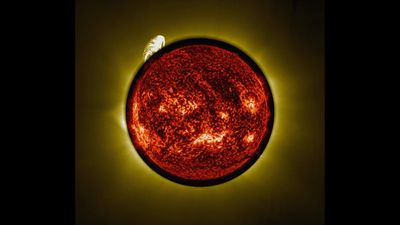


The European Space Agency’s Proba-3 is a marvel of engineering. Two spacecraft fly in formation to observe the Sun. Well, not exactly the Sun, but its atmosphere: the corona. The two spacecraft get into an alignment so that the one that is Sun-side blocks the solar disk as it happens during a solar eclipse, while the one behind instead looks at the emission of the corona.
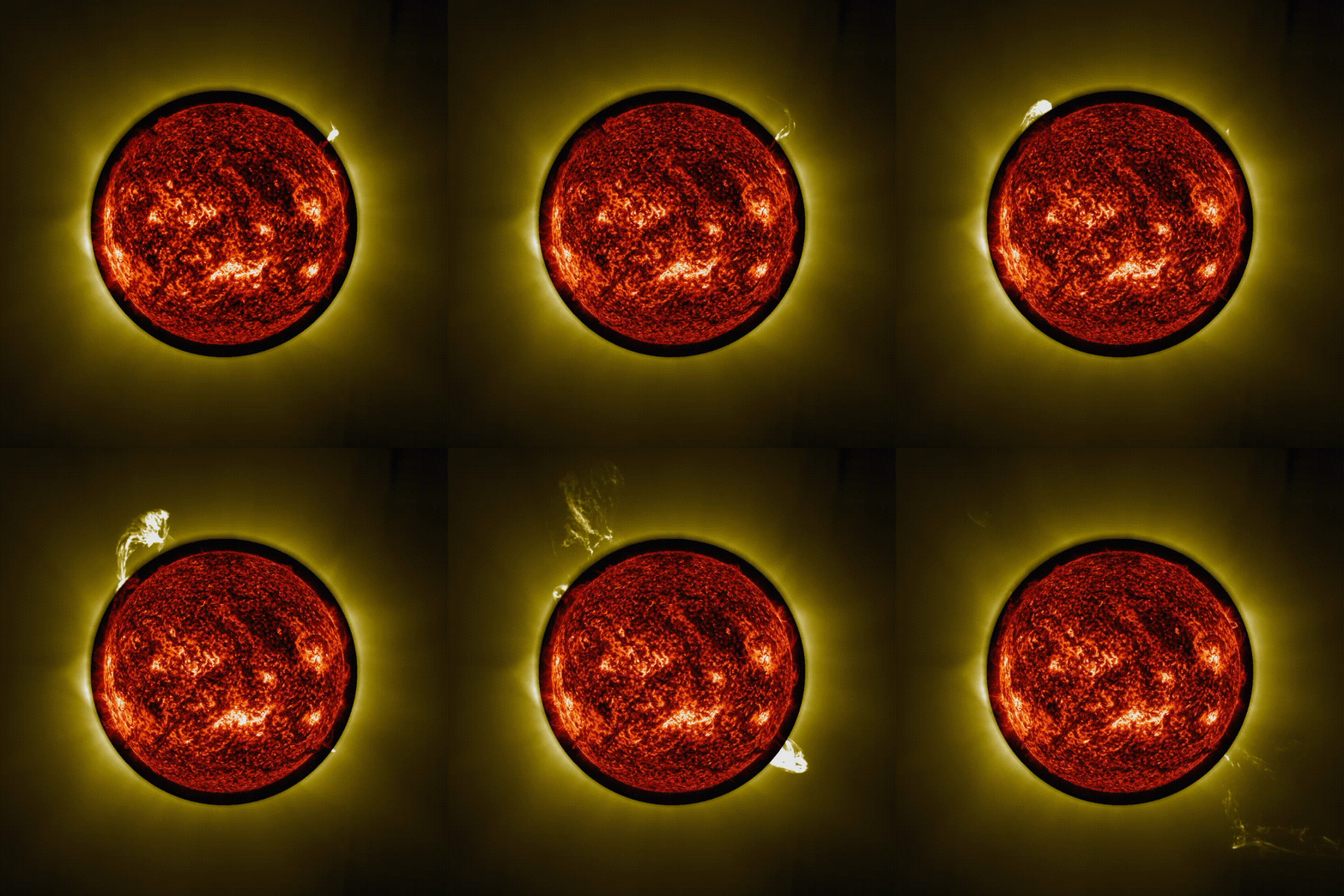
In observations collected on September 21, 2025, the spacecraft snapped not one but multiple eruptions in the solar corona. Matching Proba-3 observations with NASA’s Atmospheric Imaging Assembly (AIA) aboard NASA’s Solar Dynamics Observatory, we can now see the process as a whole.
“The corona is extremely hot, about two hundred times hotter than the Sun's surface,” Andrei Zhukov from the Royal Observatory of Belgium, Principal Investigator for the ASPIICS coronagraph aboard Proba-3, said in a statement.
“Sometimes, structures made of relatively cold plasma (charged gas) are observed near the Sun – although these are still around 10 000 degrees Celsius, they are much colder than the surrounding million-degree hot corona – creating what we call ‘a prominence’.”
Due to the formation flying, Proba-3 is not always under “eclipse” mode. The observations window this time was five hours, with images collected every five minutes. Still, it was a surprisingly exciting five hours.
“Seeing so many prominence eruptions in such a short timeframe is rare, so I’m very happy we managed to capture them so clearly during our observation window,” added Zhukov.
Proba-3 will observe the Sun during the total solar eclipse happening between Iceland and Spain this coming summer, and the results will be compared. A natural eclipse can get a lot more detail, but clearly, Proba-3 is doing some pretty good work.