Space and Physics
 PUBLISHED
 1
1


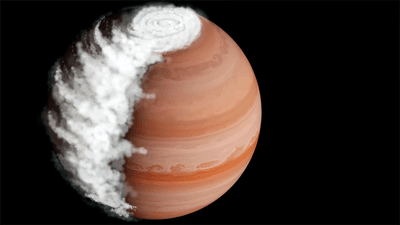


Astronomers using the JWST have found that exoplanet WASP-94A b appears to have some pretty exotic weather, forming clouds of rock every morning, which then vanish in the planet's night.
WASP-94A b was first discovered in 2014, orbiting an F-type star around 689 light-years from Earth. The planet is an extreme one. Known as a "hot Jupiter", this gas giant is around 1.58 times the radius of our largest gas giant, and is orbiting its host star extremely closely. At just 0.055 astronomical units (AU) away – with one AU being the average Earth-Sun distance – the planet takes just four days to complete an orbit, far closer than even Mercury's orbit.
The planet presented a little bit of a mystery when it was first studied, with early observations suggesting it contained hundreds times more carbon and oxygen than Jupiter, challenging our ideas about how these planets form. New observations have cleared up that mystery, with a team finding that the planet contains only around five times the amount of oxygen and carbon of Jupiter, making its formation plausible within existing planetary-formation models.
While that mystery has vanished, viewing the planet during transit across its host star, and with a more powerful space telescope, the team found a new one to get stuck into.
"With the Hubble telescope, when we used to do this type of observation, we got an average view of the whole planet with data from the clouds and the atmosphere squished together and indistinguishable," first author Sagnick Mukherjee, a postdoctoral fellow at Arizona State University, who was a student at Johns Hopkins and UC Santa Cruz at the time of the research, explained in a statement.
"This approach with the JWST lets us localize our observations, which helped us see the cloud cycle."
The team was able to get a good look at the weather on the planet, one of the first times that the cloud cycle has been observed on a hot Jupiter.
"I've been looking at exoplanets for 20 years, and general cloudiness has been a thorn in our side. We've known for quite a while that clouds are pervasive on hot Jupiter planets, which is annoying because it's like trying to look at the planet through a foggy window," co-author David Sing, a Bloomberg Distinguished Professor of Earth and Planetary Sciences at Johns Hopkins, added.
"Not only have we been able to clear the view, but we can finally pin down what the clouds are made out of and how they're condensing and evaporating as they move around the planet."
During transit, the team was able to distinguish between the planet's leading side, representing the morning side of the planet, and its trailing edge, representing the evening side of the tidally locked planet. Of course, it could not observe the incredibly hot day side, where temperatures are thought to exceed 1,000°C (1,832°F), as this was facing the star from our perspective.
The team found large differences between the morning and evening sides. Whereas the morning side had clouds crammed full of magnesium silicate, a mineral that is commonly found in rocks back here on Earth, the evening side showed little sign of these clouds at all.
"It was a huge surprise. People have expected some differences, like it's cooler in the morning than the evening – that's something natural that we experience here on Earth," Sing added. "But what we saw was a real dichotomy between the weather on both sides of the planet, and huge differences in cloud coverage, and that changes our whole picture of the planet."
"We cannot determine the specific species responsible for the clouds from our observed spectrum," the team notes in their paper. "Silicate clouds might be composed of other Si-containing minerals such as fosterite (Mg2SiO4) or quartz (SiO2) rather than MgSiO3 [magnesium silicate], but this does not affect our conclusions."
While further observations of WASP-94A b and other hot Jupiters are necessary, the team believes there are two possibilities for the vanishing rock cloud situation. In one scenario, the clouds evaporate as they move into the day side of the planet, like fog on Earth, but with minerals we would find in rocks here on Earth. Another is that the clouds are dragged deep inside the atmosphere of the planet's day side by strong, howling winds.
Either way, we're looking at a pretty gnarly exoplanet. And given that these are some of the first observations of clouds on a hot Jupiter, with similar clouds being found by the team on WASP-39 b and WASP-17 b, it might not even be that unusual.
The study is published in Science.