Nature
 PUBLISHED
 3
3


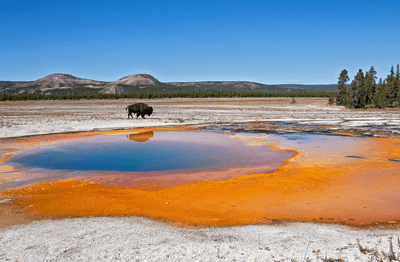


Deep beneath the Yellowstone Supervolcano, reservoirs brimming with explosive magma are hinting that future bouts of volcanism may now be more likely in the northeast of the region.
By studying the natural electromagnetic fields around the Yellowstone Caldera, scientists at the US Geological Survey and Oregon State University found at least seven reservoirs of high magma content. Located at various depths from 4 to 47 kilometers (2.5 to 29.2 miles), around the point where the crust meets the mantle, some of these reservoirs appear to be linked and may feed into each other like a complex warren.
The new findings suggest that volcanic activity in the western end of Yellowstone could be waning. In certain parts of the caldera's complex, chambers of magma are stored in segregated regions with low melt fractions, meaning these areas are unlikely to erupt.
Meanwhile, the researchers found a significant reservoir of magma associated with explosive eruptions (rhyolitic magma) beneath the northeast Yellowstone Caldera.
This northeastern reservoir of "rhyolitic melt storage" is being fed by basalt that’s moving up from Earth’s lower crust, supplying it with heat and material. It’s cooked up a situation where the underground reservoir is filled with up to 440 cubic kilometers of magma, a similar amount to that involved in Yellowstone’s Mesa Falls eruption some 1.3 million years ago.
As such, the team concludes that the location of "future rhyolitic volcanism has shifted to northeast Yellowstone Caldera.” In other words, explosive eruptions could be more likely in this region.
Bear in mind that this is not necessarily an indication Yellowstone is brewing an imminent eruption. Volcanoes are fueled by geological forces that work on lengthy timescales, typically measured in millennia to millions of years, not months or years. While there may be signs of magma movement or other volcanic activity, these processes usually unfold very slowly compared to human timescales.
Yellowstone has had three immense explosive volcanic eruptions over the past 2.1 million years: one 2.08 million years ago, another 1.38 million years ago, and the latest 631,000 years ago. The average time between these immense explosive eruptions is approximately 725,000 years. Since the last major eruption was 631,000 years ago, you could infer that the Yellowstone Supervolcano is due for another flare-up. Rest assured that this would be misleading – volcanoes don’t work on regular schedules like clockwork.
Then again, volcanic activity is notoriously tricky to predict, so let's never say never...
The study is published in the journal Nature.