Space and Physics
 PUBLISHED





What you’ll discover in this article
- Venus probably suffered an impact similar to the one that produced Earth's Moon.
- The survival of any moon formed this way appears to depend primarily on the rate at which the planet spins after collision.
- Talking to IFLScience, Professor Stephen Kane said: "Tidal forces rise very steeply with closeness, so a moon around Venus exerts a disproportionately strong torque, despins the planet faster, and thereby undermines its own orbit more quickly."
If a giant impact like the one that formed Earth’s Moon struck Venus, it’s unlikely the resulting companion would have survived to this day, new modelling shows. Indeed, the combination of circumstances required for such a moon to last more than a billion years is extraordinarily unlikely.
Besides being our home, one of the things that makes Earth distinct amongst the inner planets is the presence of such a large moon. Astrophysicists have pondered whether the absence of moons around Venus and Mercury is a sign that neither planet ever had any, or if such satellites could have once existed before being lost.
To answer at least part of this question, a team led by Professor Stephen Kane at the University of California, Riverside, modeled what would happen to a moon that formed out of the debris of such a giant impact. Their work is scheduled to be published in the Astrophysical Journal but has not yet been peer-reviewed.
The existence of Earth’s Moon is often presented as a piece of extraordinary good fortune, the produce of exceptionally unlikely events.
“The specific circumstances that produced Earth's Moon, the impactor size, angle, and speed, were fairly particular," Kane told IFLScience. “But giant impacts in general were common in the late stages of terrestrial planet formation, as they're a routine part of how rocky planets finished forming."
“So the statement isn't that Venus likely had an Earth-Moon-like impact, but rather that Venus likely experienced at least one large impact of some kind (probably many more), as most models of that era predict,” Kane continued.
“Whether such an impact produced a debris disk capable of forming a moon is a separate and much less certain question, and part of what makes Venus interesting is that it may not have.”
In or out?
Many factors would have influenced whether such an object was pushed out until it left Venus’s gravity well, migrated inwards within the Roche limit and was pulled apart, or survived for more than four billion years. Some of these are known quantities, such as Venus’s mass and its distance from the Sun, which can be fed into models.
Other quantities can only be guessed at, such as the rate at which Venus rotated immediately after the possible moon-forming collision, which is crucial to the hypothetical moon’s survival. That’s because the length of a planet’s day affects whether tidal interaction between the planet and moon push the moon out, as is happening in our own system, or pull it inwards.
If either change takes place too rapidly, there won’t be a satellite there by the time anyone on a neighboring rock is technologically advanced enough to go looking.
Using what we know, and testing a range of values for what we don’t, Kane and co-authors found a Venusian moon would almost certainly have been doomed from the start.
Even if an impact created a debris disk that condensed into a moon, a Venus whose day immediately post-impact lasted more than 12-15 hours would have pulled the moon in until it broke up. The survival time would have been 30 million to 1.7 billion years, either of which is a fraction of Venus’s life so far.
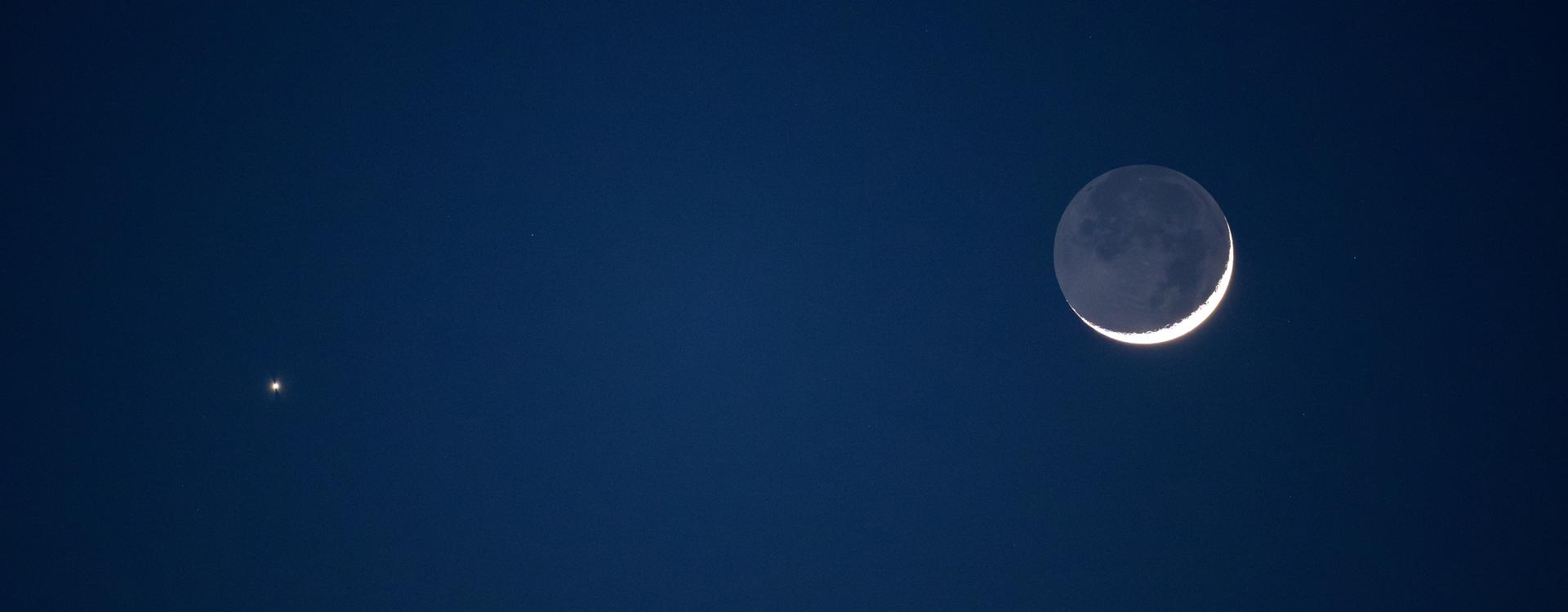
Since Venus’s day now lasts 243 times as long as ours do – which is, interestingly, longer than its year – it might seem obvious that it could never have been shorter than 15 hours, let alone 12. However, it is thought that the thick Venusian atmosphere and tidal interactions with the Sun have slowed Venus down, and that at one point its day was drastically shorter.
Whether that was less than 12-15 hours is another matter. Even a short rotation period might not be enough. If the orbit of the presumed proto-moon was fairly eccentric, or the moon was larger than ours, survival chances would be lower.
Why so different?
Venus is only a little less massive than Earth, so to those not experts in the field, it’s easy to assume its chances of holding on to a moon should be similar to our planet's. However, Kane and colleagues note that, being closer, the Sun’s gravity exerts more of an influence on Venus than on Earth, and this creates tidal effects that make it harder to keep a satellite.
Moreover, Kane told IFLScience: “The bigger factor is Venus itself… The difference with Earth is that Venus's smaller gravitational influence (its Hill sphere) forces a moon to orbit relatively closer in, and tidal forces rise very steeply with closeness, so a moon around Venus exerts a disproportionately strong torque, despins the planet faster, and thereby undermines its own orbit more quickly.”
Tiny moonlets like those of Mars follow different rules, but a moon of approximately the size of our own really does need a large planet to hold onto it.
Implications for other star systems
Kane says one of the implications of this study is that even a planet of Earth’s mass and distance from the Sun would have doomed its moon if it had rotated more slowly.
“Our results show there's a threshold spin rate below which a moon spirals inward to destruction rather than outward to safety. Earth formed spinning fast enough (a day of only a few hours) to be comfortably on the "safe" side,” Kane added. However, if the Earth’s rotation after the impact had been similar to what it is today, Armstrong’s small step would have been into empty space.
“Our work does suggest that moon survival is not guaranteed,” Kane added. However, he says it is premature to suggest that most Earth-like planets orbiting other stars would lose their moons. He thinks it’s probably common for planets at Earth-like distances from their stars to spin rapidly, protecting their moons.
“The planets most affected are the ones that both orbit close to their star and spin slowly, such as the Venus-like cases,” Kane said.
Just how important this is for the prospects of finding extraterrestrial life is uncertain, Kane added. Many reasons have been proposed why a large moon contributes to making a planet habitable, at least for land animals, but these remain controversial.
Nevertheless, a large moon would have stabilized Venus in several ways, which might have saved it from turning into the hellhole it became. Sadly, however, it seems planets will probably need to be a lot more like Earth than Venus to keep such a companion.
The study has been accepted for publication in the Astrophysical Journal and a preprint is available on ArXiv.