Space and Physics
 PUBLISHED
 4
4


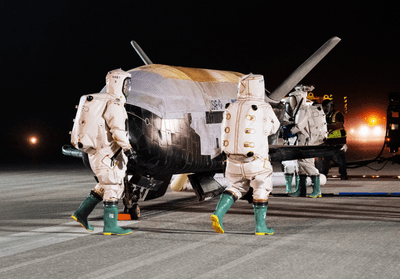


The US Space Force's mysterious X-37B space plane has been orbiting Earth non-stop for just over a year. Doing what? That remains unclear, though its masters have disclosed some of its activities in 2024.
X-37B blasted off on its latest mission on December 28, 2023, quietly surpassing the 365-day mark without any official announcement or fanfare.
The experimental spaceplane is no stranger to long flights, though. Back in 2022, it completed its sixth flight, wracking up 908 days in orbit.
Now on its seventh reported mission, the X-37B recently demonstrated a novel technique known as aerobraking, where atmospheric friction is used to lower a spacecraft's orbital altitude while expending minimal fuel. It pulled off this feat to “safely dispose” of some module components in Earth’s orbit. In other words, they’re dumping some space junk.
X-37B was designed by Boeing and is currently managed by the US Air Force as part of their foray into reusable space technologies. For each mission, it’s carried into space by a launch vehicle, cruises freely in Earth’s orbit, then re-enters the atmosphere and lands as a spaceplane.

The uncrewed spacecraft measures 8.9 meters (29 feet) in length, with a wingspan of 4.55 meters (14.9 feet). It’s capable of cruising in low-earth orbit, between 240 to 800 kilometers (150 to 500 miles) above the Earth, at speeds of around 28,200 kilometers (17,523 miles) per hour.
While the US Space Force and Boeing appear to be pulling back the curtain on some aspects of the X-37B's operations, much of its mission remains cloaked in secrecy, leaving an air of intrigue around the enigmatic spacecraft.
The official line of the US military is that X-37B performs “risk reduction, experimentation and concept of operations development for reusable space vehicle technologies” – a vague statement that offers little insight into its true purpose.
What we do know, however, is that the spaceplane has been contributing to a long-term study on how space radiation impacts seed viability and testing radiation-shielding thermal coatings for NASA.
There has been speculation that the X-37B might be some form of spy plane or weapon. However, most of these claims have been dismissed. For one, it’s relatively easy to track and creates quite a spectacle upon re-entry – hardly ideal for covert surveillance and snooping the skies.