Nature
 PUBLISHED
 1
1


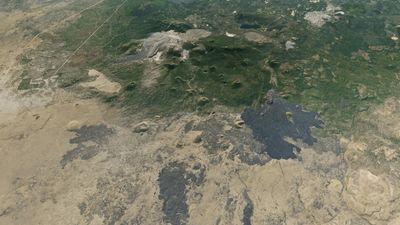


In the northeastern region of California, close to its border with Oregon, lies the Lava Beds National Monument. Here, a half-million years of eruptions from an unassuming looking volcano have left their mark, creating a rugged, geologically rich landscape.
Medicine Lake volcano
The big cheese responsible for all of the cool geological features seen at the monument is none other than Medicine Lake volcano. The volcano’s flanks are home to many volcanic formations, such as spatter cones and cinder cones formed from eruptions.
It’s also a shield volcano. Though it slopes for several kilometers, the volcano stands at only 2,412 meters tall. That might seem a little modest considering other nearby volcanos are nearly double that elevation – according to the National Park Service, a lot of visitors don’t even realize they’re on the side of a volcano when driving into the monument.
But what Medicine Lake volcano lacks in height, it’s certainly more than made up for in its impact on the surrounding landscape.
Lava flows
With their gentle slopes, shield volcanos like Medicine Lake are known for their lava flows. At the monument, they’re particularly extensive; there’s evidence of over 30 separate lava flows throughout the park, surrounding more than 50 kilometers of the volcano’s caldera and consisting of a variety of different materials.
The most recent of these flows include the Callahan flow, the result of an eruption 1,200 years ago, and the Glass Mountain flow, from around 950 years ago. To most people, this sounds like a decent chunk of time in the past, but to geologists, it’s relatively recent. As a result, the Medicine Lake volcano is considered to be active, even though it’s currently dormant.
Lava tubes
Where there are lava flows, sometimes, there can also be found lava tubes – and Lava Beds National Monument is a great example of where this can happen. There are over 700 lava tubes found in the monument and you can even go into some of them.

Lava tubes form when the edges of lava flows begin to cool and harden, creating a crust across the molten rock below, which burrows into the ground as it continues flowing. Eventually, when an eruption ends or the lava flows elsewhere, the channel drains, leaving behind a lava tube.
Whilst it’s more common to find lava tubes as a single long channel, the ones found in Catacombs Cave at the Lava Beds National Monument are of a more unusual, complex type. Not only does the tube split into multiple different passages, but there are also levels of tubes stacked on top of each other, connected by short pits. This can happen when a volcano has had multiple eruptions, with fresh lava flowing over an existing tube.
But whilst Lava Beds National Monument is home to some pretty long lava tubes, it doesn’t quite nab the title for the longest cave system in the world.