Space and Physics
 PUBLISHED
 2
2



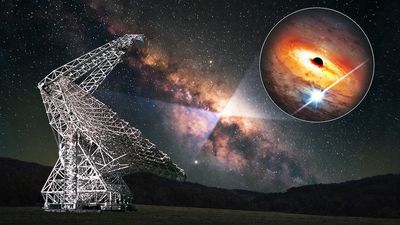


Pulsars are a special class of neutron stars that spin very quickly on their axes, releasing pulses of radio waves. These beats are so precise that pulsars are only beaten as accurate clocks by some of the atomic clocks that humans have devised. Researchers might now have found an exceptional pulsar, right at the center of the Milky Way. If this is correct, it could have the power to revolutionize physics.
One thing at a time, though! First, the object. The candidate pulsar is a millisecond pulsar, meaning that it spins hundreds of times every second. The signal from this possible pulsar repeats every 8.19 milliseconds. This already is exciting because there are several hundred millisecond pulsars in the galaxy, so adding one more is very good.
The second reason is simple: location, location, location! The millisecond pulsar appears to be near Sagittarius A*, the supermassive black hole at the center of our galaxy. Sagittarius A* weighs approximately 4.3 million times the mass of our Sun, and its formidable gravitational pull warps spacetime around it.
Sagittarius A* has already been used in tests of Einstein’s theory of general relativity. If the candidate pulsar really is there, its pulsation would be affected by the gravity, and it would provide tests of Einstein’s work at an unparalleled level, allowing us to gain new insights and even discover possible limitations. Relativity and quantum mechanics do not work together, but we have not found yet found a specific direction to focus our unification efforts. A pulsar orbiting a supermassive black hole could help a lot!
“Any external influence on a pulsar, such as the gravitational pull of a massive object, would introduce anomalies in this steady arrival of pulses, which can be measured and modeled,” co-author Slavko Bogdanov, from the Columbia Astrophysics Laboratory, said in a statement. “In addition, when the pulses travel near a very massive object, they may be deflected and experience time delays due to the warping of space-time, as predicted by Einstein's General Theory of Relativity.”
The observations made by the Breakthrough Listen Galactic Center Survey. It is part of Breakthrough Listen, a scientific research program looking for alien civilizations' signals in radio waves.
Due to the importance of this possible discovery for general relativity, the team has released the data publicly so that other researchers can analyze it and run their own tests. They are also conducting follow-up observations to confirm if the finding is indeed correct and located where they hope it is.
“We’re looking forward to what follow-up observations might reveal about this pulsar candidate,” lead author and Columbia PhD graduate Karen I. Perez explained. “If confirmed, it could help us better understand both our own Galaxy, and General Relativity as a whole.”
The study is published in The Astrophysical Journal.