Space and Physics
 PUBLISHED
 2
2


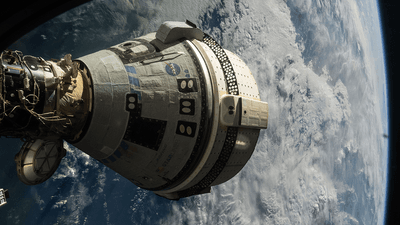


A strange pulsing sound has been heard from Boeing's troubled Starliner spacecraft, prompting a concerned comment from seasoned astronaut Chris Hadfield.
Astronauts Suni Williams and Butch Wilmore departed for the International Space Station (ISS) on June 5, the third and final test of Boeing's new Starliner capsule, and its first launch with a crew. The mission was only expected to last for eight days – but due to problems with Starliner's thrusters and a helium leak, the two remain stranded on the space station nearly three months later.
It had been hoped that the spacecraft could be fixed as it is docked to the ISS, but after a long assessment, NASA has now abandoned plans to bring the two home on board Starliner. On August 24, NASA announced that they would instead be sending the capsule back to Earth empty, and the two astronauts will have to wait for a seat on SpaceX's Dragon spacecraft to return them to Earth when it next docks with the space station in February 2025.
That's a pretty bad situation, but surely it couldn't possibly get any worse, right? Not so fast. Over the weekend, astronauts began to hear a strange sonar-like noise coming from the Starliner capsule.
"I've got a question about Starliner," Wilmore said to Mission Control, as heard in audio posted to NASA's Spaceflight Forum by meteorologist Rob Dale. "There's a strange noise coming through the speaker [...] I don't know what's making it."
The unusual noise prompted a concerned comment from retired Canadian astronaut Chris Hadfield, who has previously served as commander of the ISS.
The noise, described as a "pulsing noise almost like a sonar ping" by Mission Control, did not appear to trouble NASA or Wilmore. Strange noises are sometimes heard in space, and there is no reason to believe that this is detrimental to the crew on board.
One plausible, though unconfirmed, explanation is that the sound is caused by a simple feedback loop.
"There is a 500 milliseconds return ping between earth and ISS, which happens to be the same delay between these pulses that we're hearing," one person wrote on Reddit, suggesting feedback as a solution. "So it is likely that in some totally quiet, closed room at NASA a microphone is open, and transmitting sound to the starliner speakers, and across the room from that microphone at NASA is a speaker, playing the sound coming down from starliner with a huge delay."
For now, the noise remains a mystery, another oddity in a pretty unsuccessful test of Boeing's Starliner. The noise will not trouble astronauts for too long, with the capsule set to undock from the ISS on September 6 and return to Earth on September 7.
[H/T: Ars Technia]