Culture and Society
 PUBLISHED
 3
3


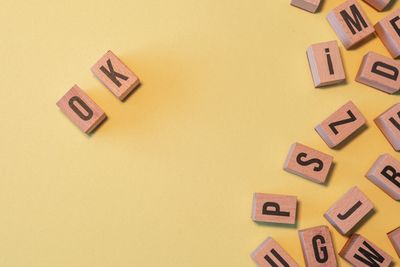


From Toronto to Timbuktu, from Buenos Aires to Bangkok, and from Paris, Texas to Paris, France, there’s one word that almost anybody will understand. It’s short – just two letters long, traditionally – and it has myriad definitions. Oh – and nobody is totally sure how it came to exist.
It’s OK. Let’s talk about it.
What’s the deal with OK?
OK is a great word. It can mean both “good” and “not good” – compare “it’s OK” and “it’s just OK”; it can mean “well”, as in, “I’m OK”; it can be a verbal tic or a filler word; an affirmative or an expression of doubt; an authorization; an approval; even just an interjection – as in: OK! Enough examples already!
It’s at home in any situation, equally useful in the original edition of Little Women and on the surface of the Moon. It’s used by Presidents and paupers; scientists and salespeople; in virtually every way possible, it’s basically the universal word.
It’s also undeniably strange. “It's a word that looks and sounds like an abbreviation,” pointed out forensic linguist Allan Metcalfe, author of 2010’s OK: The Improbable Story of America's Greatest Word, in a 2011 article for the BBC.
“We generally spell it OK – the spelling OKay is relatively recent, and still relatively rare,” he pointed out, “and we pronounce it not ‘ock’ but by sounding the names of the letters O and K.”
It even looks weird, Metcalfe wrote – the big round O paired with the spiky K; bouba meets kiki in a single word. And it all adds up to something even more peculiar than the sum of its parts: “Ordinarily a word so odd, so distinctive from others, wouldn't be allowed in a language to begin with,” Metcalfe explained. “As a general rule, a language allows new words only when they resemble familiar ones.”
All of which raises an obvious question, namely: where the heck did OK come from? And how did it become so successful?
An OK origin story
Considering how much it’s used, OK is a very mysterious word. Unlike just about every other word in the dictionary – dog, boy, and donkey notwithstanding – there was, for a very long time, no obvious origin point for OK. “For etymologists, establishing the origin of OK became something of an obsession, equivalent to mathematicians' long quest for the proof to Fermat's last theorem,” reported The Economist back in 2002.
“Americans assumed that OK must be of American origin, if only because it was so successful,” it explains. “Germans said it was the initials of the [fierce]-sounding rank of Oberst Kommandant. The French put in a claim for Aux Cayes, a town they had established in Haiti that produced superior rum. A British scholar said the use of OK in Britain predated any American influence and had probably come from Elizabethan English.”
What else? Well, there were those who said it was Scottish, linking it with the phrase och aye; others thought it was Greek in origin, pointing to teachers’ use of the phrase Ὅλα Καλά – “everything is fine” – when marking satisfactory work. Perhaps it was Finnish, and a corruption of “oikea”, meaning “correct”; maybe it went all the way back to Latin, with the initials of the phrase “Omnis Correcta” – all is correct – albeit, ironically, misspelled.
Other theories linked the word to specific industries. Maybe it came from the initials of “outer keel”, branded on the timbers of ships to ready them for construction. No, probably it was invented by early telegraph operators – a shortening of “open key”, meaning “ready to transmit”. Oh, no: it was German typesetters and publishers, marking accepted manuscripts with the phrase “Ohne Korrektur” – “without correction”. Was it the London astronomers who certified timepieces and instruments with the initials of the King’s Observatory? Or was it soldiers in the American Civil War, reproducing the letters they saw on their standard-issue Orrin Kendall biscuit rations?
Maybe the origin was forgotten precisely because of where it came from. Similar-sounding affirmative phrases were pointed out in languages like Wolof, Mandinka, and Djabo – those spoken by enslaved people brought to the US from West Africa – in which “waaw-kay”, “o ke”, and “O’-ke” respectively translate to an emphatic “yes” or “that’s it”.
Or perhaps it was originally the Choctaw phrase “okeh” – “it is” – brought into the English language either by frontiersmen trading with the Native American populations, or by Andrew Jackson during his time as a general along the Mississippi. That explanation was particularly favored by President Woodrow Wilson, who would approve official documents by signing them “Okeh – W.W.”
All these theories – and, frankly, quite a lot more as well – had their supporters and their detractors. Things were, as the Economist puts it, “getting serious in the world of etymology.”
And so, in the 1960s, one man set out to find the real answer.
OK: the real story. Probably.
Allen Walker Read was convinced of OK’s American origins – but narrowing down when, where, and why the word first surfaced would prove to be a long undertaking. First, he had to sort through what he called the more “frolicsome” explanations: then, he had to provide his own – and more importantly, justify it.
At first, he quite liked the “Orrin Kendall” and “open key” ideas – but the more he researched, the less likely they seemed. The killing blow: an article on page 2 of the Boston Morning Post dated Saturday, March 23, 1839 – more than 20 years before the Civil War, and half a decade earlier than the first ever telegraph message.
No earlier example of the word has yet been found in writing, so this is the origin currently accepted by most etymologists. But here’s the weird part: the article itself explains the word as an initialism standing for the phrase “all correct” – so why isn’t it “ac” instead?
Well, it turns out “ok” – a word eminently useful and almost universal – most likely started as a joke. And probably not even a very good one: “Beginning in the summer of 1838, there developed in Boston a remarkable vogue of using abbreviations,” explained Read in one of his many papers tracing the history of OK. “It might well be called a craze.”
This part, at least, is pretty familiar (dyt? ymmv ig) – but here’s the twist: for some reason, this fad of abbreviation went hand-in-hand with another trend of purposely misspelling words (pretty kewl, rite?) Thus the American public saw, for a period, such slang as “O.W.” – “oll write”, i.e. all right – K.G. for “know go” to signal something was a, well, a no-go, and, of course, O.K. – “oll korrect”.
So, that’s weird – but plausible. Still, it feels like we only have half the story so far, doesn’t it? “OK became one of the more commonly used initialisms,” notes Merriam Webster, but “it might have passed into oblivion when the linguistic fad had passed if not for the presidential election of 1840.”
Voting OK!
How could a presidential election give us the word OK? It’s got nothing to do with the Sooner State – no: the final ingredient in OK’s success comes from much further north. Specifically, Kinderhook, New York.
Why? Because that was the hometown of Martin Van Buren, the incumbent president whose supporters called themselves the “OK Club” in reference to his nickname: Old Kinderhook. It sounds overly convenient, perhaps, but that kind of moniker was popular at the time – in fact, his rival in the election, William Henry Harrison, was known as “Old Tippecanoe”, and his predecessor, Andrew Jackson, had been “Old Hickory”.
In total, then, the story of “ok” is this: a faddy joke that should have died out quickly – but, thanks to a curious twist of fate, ended up catching on and spreading not only around the world, but to the Moon as well. It would be like if newspapers started wryly using “T” for “tea” to refer to inside information or truth, only for presidential candidate Mr T to make it his entire campaign, and then 200 years later it was one of the most popular words in the world.
Of course, that’s assuming Read got the history correct. To this day, there are people who reject the “oll korrect” explanation: some blame Andrew Jackson’s supposedly poor spelling, and Germans will apparently die on the hill that it stands for Otto Kaiser, the name of some theoretical industrialist who marked his factory’s satisfactory produce with his initials.
But whatever its origin, OK is here to stay. And that’s OK.
“It's not that it was needed to ‘fill a gap’ in any language. Before 1839, English speakers had ‘yes’, ‘good’, ‘fine’, ‘excellent’, ‘satisfactory’, and ‘all right’,” Metcalfe pointed out.
But “what OK provided that the others did not was neutrality,” he explained. “A way to affirm or to express agreement without having to offer an opinion.”
“OK allows us to view a situation in simplest terms,” he said. “Just OK or not.”