Space and Physics
 PUBLISHED
 4
4



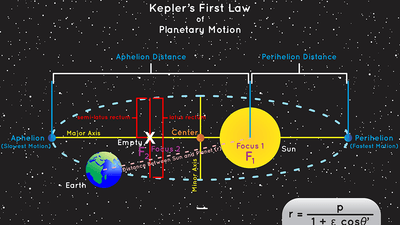


Today, 6 July 2026, Earth reaches its aphelion, our furthest point from the Sun on our yearly journey around it. As always, this has quite a few people confused, with our furthest point from our host star occurring in the summer months for a lot of Earth's population.
We'll explain how the seasons work shortly, but let's start with a little astronomy history for fun. We've known Earth is (roughly) spherical since ancient times, and we even got an impressively accurate measurement of its circumference over 2000 years ago thanks to Eratosthenes, a famous well, and a stick.
Orbits, meanwhile, took a lot more figuring out. We have a whole article on that, but essentially, for a long time humans assumed Earth was at the center of the universe, and the planets, or "wanderers," that we could see weren't rocky bodies like our planet but deities or some other kind of structure embedded within a great sphere.
It took a long time and a good look at the orbit of Venus for humanity to gather some convincing (though not conclusive) evidence that the planets actually orbit the Sun.
Aristotle and the Catholic Church, who later adopted his ideas about the universe, may have significantly slowed progress on that front. The Aristotelian view, incorporated into the Ptolemaic model, had it that the heavens are perfect, and so the Sun, Moon, and planets must orbit Earth in perfect circles.
Unhelpfully, they don't actually do this. As well as the Sun not orbiting Earth (spoilers for any medieval folk out there), the planets don't orbit in perfect circles but in ellipses, with the Sun sitting at one of two focal points.
Johannes Kepler was the first to realize this, all the way back in 1609. At that time, Danish astronomer Tycho Brahe was confused by the orbit of Mars, and though he was very guarded with his astronomical observations, he turned to Kepler for assistance.
The problem was that Brahe, though an accomplished astronomer, was working on a batshit model of the solar system that had the other planets orbiting the Sun while the Sun orbited Earth.
Kepler initially thought the orbits should be circular too, though he wasn't convinced of a geocentric view of the Solar System. Try as he might, however, he couldn't figure out any way to describe Mars's orbit that retained its supposed perfect circularity.
"Kepler eventually realized that the orbits of the planets are not perfect circles. His brilliant insight was that planets move in elongated, or flattened, circles called ellipses," NASA explains.
"The particular difficulties Tycho had with the movement of Mars were due to the fact that its orbit was the most elliptical of the planets for which he had extensive data. Thus, in a twist of irony, Tycho unwittingly gave Kepler the very part of his data that would enable his assistant to formulate the correct theory of the solar system."
Mars has a pretty eccentric (or highly elliptical) orbit, making its distance from the Sun vary significantly throughout the year. Earth's is more subtle and close to circular at around 0.0167 eccentricity.
At aphelion, Earth will be around 152,087,774 kilometers (94,502,961 miles) from our host star, while at perihelion – its closest approach to the Sun – our planet is around 147.1 million kilometers (91.4 million miles) away from it.
During aphelion, sunlight reaching Earth is around 7 percent less intense than at perihelion. Despite this, the average temperature across Earth is actually higher. This is because of the arrangement of land, more of which is in the northern hemisphere, and the Earth's 23.5-degree axial tilt.
"We're closer to the Sun in January," Roy Spencer at NASA's Global Hydrology and Climate Center explained to Space Weather, "but the extra sunlight gets spread throughout the oceans."
"The average temperature of the whole earth at aphelion is about 4°F or 2.3°C higher than it is at perihelion," he added.
Nevertheless, we doubt people are confused about the average global increase in temperature at aphelion. The main reason people are confused is because they are in the northern hemisphere and appear not to realize that the summer season is caused by Earth's axial tilt.
Despite us being further away, the northern hemisphere is pointed towards the Sun right now, leading to higher temperatures in that part of the world. People in the southern hemisphere tend not to have this question, as they are going through winter as aphelion approaches.
This actually won't be the case forever. Because our calendars don't perfectly match our orbit around the Sun, the timings of aphelion and perihelion are shifting throughout the years.
Aphelion and perihelion are currently very close to the summer and winter solstices, respectively (or the shortest and longest days of the year, again due to our axial tilt). If you go back to 1246 CE, however, the December solstice took place on exactly the same day as perihelion.
Since then, these dates have drifted apart from each other at a rate of around one day every 58 years. Per timeanddate.com, in 6,430 CE, perihelion will coincide with the March equinox.
So in short, to answer the question of the title, the Earth's furthest point from the Sun only takes place in summer for one hemisphere. And it won't be like that forever, either.
Correction: An earlier version of this article had a typo that implied Earth orbits another planet. This has been corrected to refer, of course, to the Sun.