Space and Physics
 PUBLISHED
 3
3



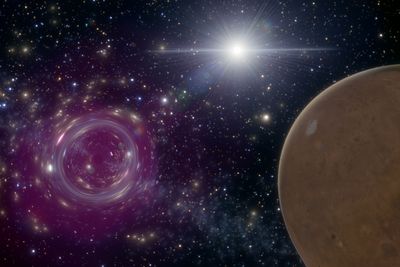


Astronomers have proposed a bold new detector for dark matter: the planet Mars. We know the position of the Red Planet with exquisite precision and if there was a certain type of dark matter passing through the Solar System, the planet’s orbit would change by a tiny amount. The orbit of Mars stretches to almost 250 million kilometers (155 million miles) from the Sun at its farthest point and it would only be around a meter in change, but it would be measurable.
We don’t actually know what dark matter is; the name is a misnomer. Dark matter outweighs regular matter five-to-one but it is not dark; it is invisible, not interacting with light, just with gravity. One possible component of this dark matter is primordial black holes, black holes that formed just a few instants after the Big Bang. These black holes need to be at least as heavy as an asteroid or they would have destroyed the universe already (more on that here).
Astronomers have calculated how often such black holes might be passing around the Solar System and what would happen if they did. They estimate that at least one of these objects would pass through the inner Solar System per decade. If by chance it was within a few million miles of Mars, it would create a little wobble in the planet’s orbit, which would eventually grow to a meter-sized difference in the celestial path of the Red Planet.
“Given decades of precision telemetry, scientists know the distance between Earth and Mars to an accuracy of about 10 centimeters,” co-author Professor David Kaiser, from the Massachusetts Institute of Technology, said in a statement.
“We’re taking advantage of this highly instrumented region of space to try and look for a small effect. If we see it, that would count as a real reason to keep pursuing this delightful idea that all of dark matter consists of black holes that were spawned in less than a second after the Big Bang and have been streaming around the universe for 14 billion years.”
The research started as a thought experiment on what would happen if one of these black holes (which are microscopic) would fly within 1 meter (3 feet) of a person. That person would be pushed 6 meters 920 feet) away from their position in a single second. From that extremely unlikely case, the team actually started considering how such a fast-moving object might tug at the inhabitants of the Solar System.
“We extrapolated to see what would happen if a black hole flew by Earth and caused the Moon to wobble by a little bit,” lead author Tung Tran, now at Stanford University, explained. “The numbers we got were not very clear. There are many other dynamics in the Solar System that could act as some sort of friction to cause the wobble to dampen out.”
Earth and the Moon were no good as dark matter detectors despite us being here, but Mars appeared to be a valid candidate. Still, the team wants to do a lot more simulations to turn this idea into a diagnostic tool for the presence of primordial black holes in the Solar System.
“We are now working to simulate a huge number of objects, from planets to moons and rocks, and how they’re all moving over long time scales,” co-author Sarah Geller explained. “We want to inject close encounter scenarios, and look at their effects with higher precision.”
The study is published in the journal Physical Review D.