Space and Physics
 PUBLISHED
 1
1


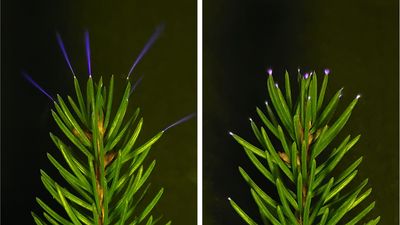


During a thunderstorm, two North Carolina trees were photographed producing an ultraviolet glow that moved among their leaves. The findings have now been replicated in other states, demonstrating that the phenomenon does not require particularly unusual circumstances. More than just a beauty denied to our eyes, the electrical discharges that cause this glow may shape trees’ evolution.
Stories of strange lights in the forest are a staple of folklore, and some of them are definitely real – like ball lightning and will-o'-the-wisps – even if we don’t fully understand them. The electric energy present before and during thunderstorms has been claimed to create strange effects of its own, but these have never been recorded.
We know that clouds can become strongly electrically charged, generating an opposite charge in the ground. When the field between is strong enough to cause a breakdown in the air molecules, lightning jumps between ground and cloud. That’s not necessarily the only way the charges can meet, however.
Unless a surface is a perfect insulator, a strong electric field will cause charges to move towards their opposite. That means ground charge flows to the highest point, usually tree tops. The weakening of electric fields without lightning has been attributed to some charges escaping leaves and reaching the clouds.
Strong electric fields can cause a glow known as a corona (but unrelated to the solar corona), and this has been shown to occur around leaves in test conditions.
"In the laboratory, if you turn off all the lights, close the door and block the windows, you can just barely see the coronae. They look like a blue glow," Pennsylvania State University meteorologist and lead author Patrick McFarland said in a statement. The coronae have been found to increase in proportion to the electric current flowing through potted plants.
McFarland and colleagues turned a car into something the Ghostbusters would envy, with a weather station, an electric field detector, and a periscope capturing light for an ultraviolet (UV) camera.
"We had to take out one of the seats and put in these vibration-dampening pads so our instruments wouldn't bounce up and down as we drove," McFarland said. "The most fun part was taking a jigsaw and cutting a twelve-inch hole in the roof. Totally killed the resale value, but that's fine."
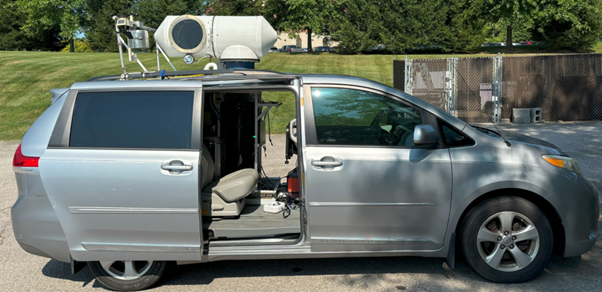
Then they went coronae hunting. "We sit there and stare at this video while the thunderstorm's raging overhead," McFarland said. "You're looking for the faintest signals on a video feed of nothing…It's really difficult to tell in real time if you're seeing anything."
Short-wavelength light is often accompanied by longer wavelengths, but the visible light is usually too weak to be seen after lightning destroys dark adaptation and low cloud reflects other sources of light.
However, the UV camera had no such problems. In the course of 90 minutes, the team identified 41 coronae on the tips of leaves in a single tree, each lasting up to 3 seconds and sometimes moving between leaves.
To prove the phenomenon is not specific to a single species, the team observed a sweetgum and loblolly pine on their original outing, and a variety of other species as they chased summer storms from Florida to Pennsylvania.
If humans could see into the UV, as bees and mantis shrimp can, "I believe you'd see this swath of glow on the top of every tree under the thunderstorm," McFarland said. "It'd probably look like a pretty cool light show, as if thousands of UV-flashing fireflies descended on the treetops."
UV refers to an enormous part of the electromagnetic spectrum, but the radiation the team photographed peaked at 260 nanometers, not very far beyond the human eye’s 380-750 nm capacity. Some radiation is also emitted at longer wavelengths that humans can see. It’s even been highly speculatively proposed that visible light coronae inspired the legend of the burning bush.
The electric discharge and accompanying radiation break down molecules in the air to produce hydroxyl (OH), an oxidizing agent that can affect the local chemistry.
The authors estimate that around 1 microamp of current was required to produce the brightness of coronae they filmed. The filmed coronae occurred during driving rain, with wet leaves carrying more current. People being more focused on finding shelter than watching lights in the tree tops probably contributed to the shortage of firm observations.
Previous experiments have proven that currents can break plant cell membranes and destroy chloroplasts – leaves’ most essential component. Since coronae are not a new phenomenon, and probably not a rare one, trees have evolved with the currents that produce coronae, and had plenty of time to adapt.
The harm from any one corona appears insignificant, but McFarland and co-authors think the effects might be cumulative when storms are frequent, and want to investigate if trees have found ways to minimize the damage.
The study is published in Geophysical Research Letters.